Motherland in My Heart
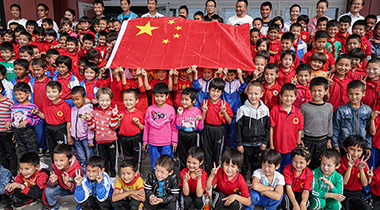
Photo by Han Shuanzhu
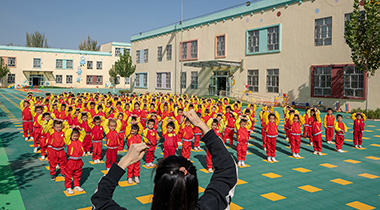
Students at a primary school in Xiaokang New District, Qira County, Hotan Prefecture are engaged in an activity to foster their love for the country. Poverty alleviation programs have granted all school-age children in southern Xinjiang access to schooling with steadily increased quality of education.
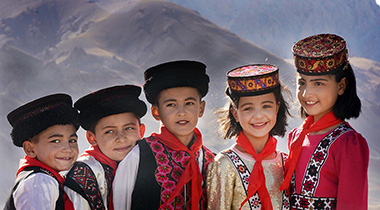
Smiles over Pamirs Plateau
Photo by Li Ge
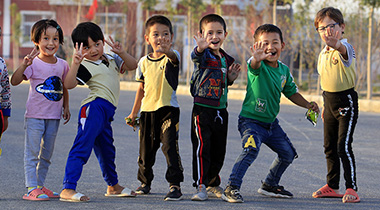
A group of smiling children in the Taxkorgan Tajik Autonomous County. Pamirs Plateau is literally the roof of the world and the Tajiks there are called “people living above clouds.” The plots in Visitors on the Icy Mountain, a well-known film among the Chinese people, took place in this county.
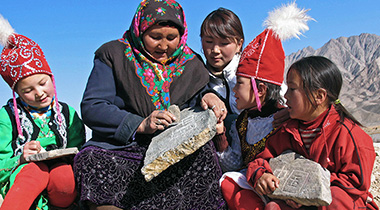
Burumahan Maoleduo
Photo by Hu Shaowu
Burumahan Maoleduo became a border guard at the age of 19. She has been patrolling the borderline near the Donggulama mountain pass for more than 50 years. In this photograph, she is telling children stories about it.
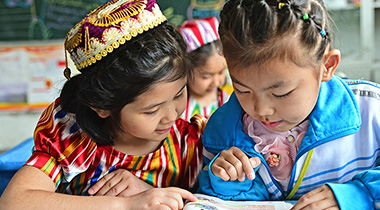
Sisters
Photo by Chen Jianfei
Han and Uygur girls are helping each other to learn and make progress together. Under the policy of ethnic equality and unity, the 56 ethnic groups in China live in harmony and develop hand-in-hand.
Let's Do Exercises
Photo by Wang Haiyan
Children, led by their teachers, are doing physical exercises at the Central Kindergarten in Nazerbag Town, Kashgar Prefecture. Promoting well-rounded education has been a major focus of education reform and development in China.
Bilingual Class
Photo by Zhang Huawei
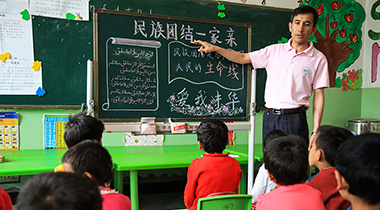
Kindergarten children are in a bilingual class of mandarin and Uygur Languages in Upal Town, Kashgar Prefecture. All children of the right age in the prefecture now have access to kindergartens.
Come On, Let's Dance
Photo by Adil Nadir
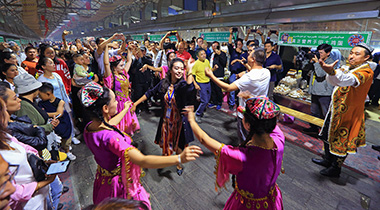
At a night market in Hotan City, tourists are dancing together with the locals. Hotan, known as the “jade capital” in China, used to be a hub on the southern route of the ancient Silk Road. The night market has become a tourist attraction for its colorful ethnic features and delicious local food.
Tuvan Horse Racing in the Snow
Photo by Meng Ge
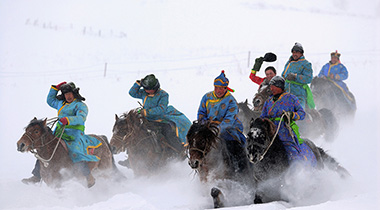
Mongolian Tuvans are galloping in the snow during a traditional horse race in Kanas Village on the northernmost border of Altay Prefecture.
Specialty Industry
Photo by Wu Zongqi
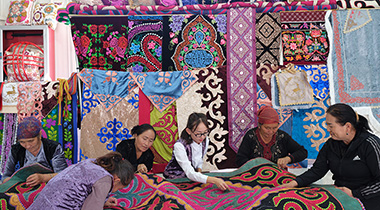
Kulichreti Muheyati, a Kazakh girl in her twenties, returned to her hometown in Altunemil Village of Tacheng City and established a carpet weaving and embroidery business. Each of the items she and her employees produce features the traditional designs of their hometown.
Warm-hearted Doctors
Photo by Qian Han
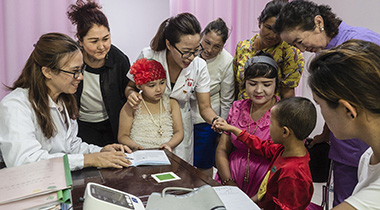
Doctors from Rizhao City, Shandong Province in eastern China are introducing basic healthcare knowledge to children at the Maternity and Child Health Care Hospital in Makit County, Kashgar Prefecture. As a nation-wide program to promote self-reliant development in Xinjiang, many hospitals in eastern and central provinces have paired up with hospitals in Xinjiang and provided assistance to them.
A Community of Harmony
Photo by Zhang Junge
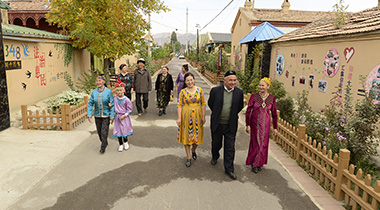
Residents in traditional costumes are taking a walk after their meals in the Hoskule Community of Tekes County in Ili Kazakh Autonomous Prefecture. Nowadays, increasing numbers of local ethnic minority households have added modern-style clothing, e.g. suits and jackets, to their closet.
Fun Games
Photo by Wang Haiyan
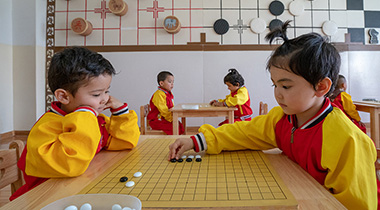
Kids are playing a game of Gobang in the Central Kindergarten of Nazerbag Town, Kashgar Prefecture. In line with the purpose of preschool education in China, it is essential to care for children’s physical and mental well-being, and ensure their happy and healthy growth.
A Family Portrait for the New Year
Photo by Zhu Mingjun
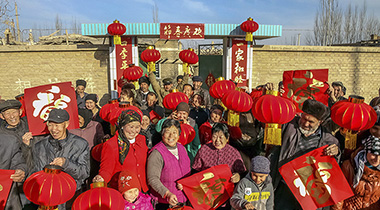
Villagers in Tuanjie Village have gathered for a group photo in celebration of the Spring Festival. By helping each other in work and life, they have been enjoying harmony and solidarity in one big family.
Enjoying the New Year's Eve Together
Photo by Sun Jiamin
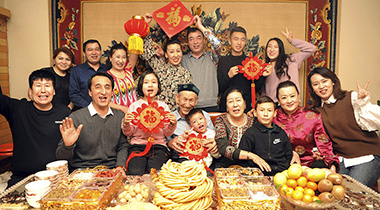
Households from different ethnic groups are spending the Lunar New Year’s Eve together. This traditional festival of China usually falls on December 29 or 30 of the lunar calendar. As the last evning of the year, it bears special importance for the Chinese people.
Technical Guidance
Photo by Han Shuanzhu
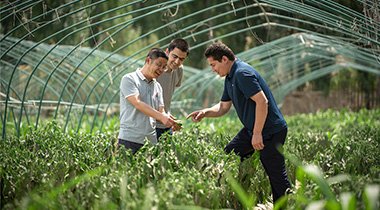
A village official is offering guidance to farmers on how to grow vegetables in a greenhouse. The annual net revenue generated by each greenhouse can reach as much as 10,000 RMB yuan. An increasing number of villagers are relying on operating greenhouses to increase their incomes and shake off poverty.
Master and Apprentice
Photo by Wu Haiyan
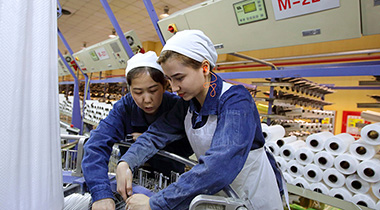
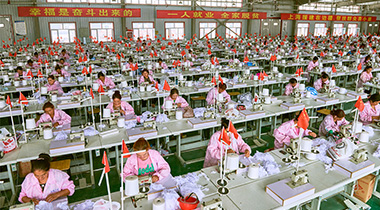
Many female workers from Shanghai have settled in southern Xinjiang. They have overcome difficulties and established businesses together with local ethnic minority groups in order to shake off poverty.
Football Dreams
Photo by Han Shuanzhu
Students are posing for a group photo with footballs in their hands. The future of Chinese football rests upon the shoulders of the younger generation. As the training needs to start from childhood, there has been increasing importance attached to school-based football training.
Kazakh People and Falcons
Photo by Jin Wei
Kazakh falconers in Qinghe County, Altay Prefecture. Training hunting falcons have long been an important part of the nomadic lifestyle of the horse-riding Kazakhs living in this region.
Solar-powered Greenhouse
Photo by Dou Jianbin and Dou Weibing
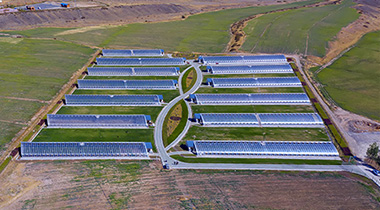
Xinjiang Yukun Heating Technology Service Co., Ltd. has participated in poverty alleviation with their technology. The company’s solar-powered greenhouse model project has opened up a new business for local farmers to shake off poverty.
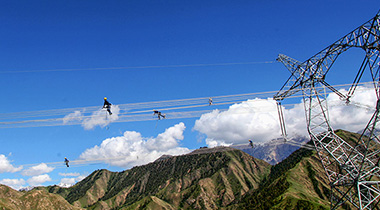
Power Supply for Poverty Alleviation
Photo by Sun Jiamin
To help alleviate poverty in the region, electricity companies are always ready to solve problems for the local people. Since the beginning of the 13th Five-Year Plan period (2016-2020), the State Grid Xinjiang Electric Power Co., Ltd. has invested a total of 98.6 billion RMB yuan, safeguarding the electric supply for rural revitalization as well as the income increase of people of all ethnic groups.
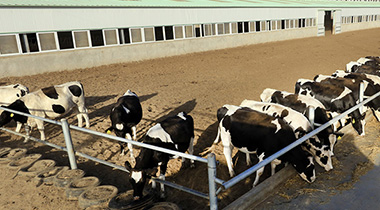
Dairy Industry for Poverty Alleviation
Photo by Sun Guofu
Xiyuchun Dairy Enterprise has settled its business in Hejiaxin Village, Luopu County, Hotan Prefecture, providing more than 150 jobs to local poor households and effectively boosting the local animal husbandry.
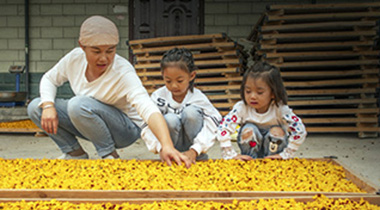
Planting Coreopsis Tinctoria for Poverty Alleviation
Photo by Xu Liansheng
Kunlun coreopsis tinctoria is a healthy product for drinks and medicine. A bumper harvest this year is sure to improve local people’s life. Targeted poverty alleviation efforts have enabled almost every household in poverty-stricken areas to master the skills for growing the plant in their fields, thus enhancing local people’s capability for self-reliance.
Fruit Industry for Poverty Alleviation
Photo by Sun Guofu
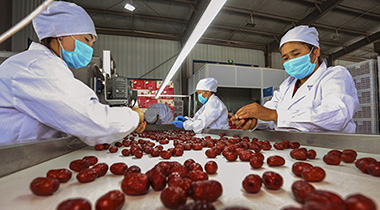
Hongri Leyou Fruit Co., Ltd. in Makit County, Kashgar Prefecture is helping local poverty alleviation efforts by employing more than 150 migrant workers in the fruit industry. These workers’ incomes have been increasing as they shift from subsistence agriculture to organized employment.
Rural Land-Use Rights Transfer for Poverty Alleviation
Photo by Han Shuanzhu
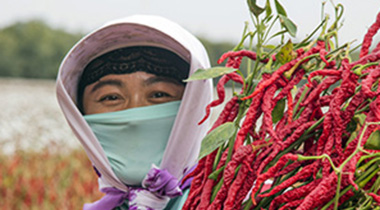
After the rural land-use rights transfer, peppers planted on a large scale have seen bumper harvests and brought tangible benefits to the villagers. The practice of rural land-use rights transfer has greatly improved the efficiency of agricultural production.
Roasted Naans of Kashgar
Photo by Zhang Guocheng
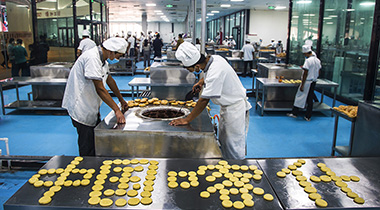
In the Naan Industrial Park of Makit County, Kashgar Prefecture, employees have placed naans (a kind of crusty pancake) into Chinese characters meaning “Kashgar in China.” As a time-honored staple food in Xinjiang, naan is truly a gourmet attraction and a distinct logo of Xinjiang.
National Day Celebration
Photo by Qi Yongsheng and Jia Jianzhong
To celebrate the 70th anniversary of the founding of the People’s Republic of China, the municipal government of Urumqi invited 70 70-year-olds and 70 7-year-olds to the Shuimogou Park where they shared a big birthday cake, sang birthday songs and ate longevity noodles.
One Man with a Job and One Family out of Poverty
Photo by Jin Wei
Many enterprises from Shanghai have established operations in Xinjiang to help improve the life of local people. It has been a key component in the Central Government’s overall planning for the new era to stipulate that other provinces pair up with cities and counties in Xinjiang to conduct large-scale one-on-one assistance.
Golden Harvest
Photo by Adil Nadir
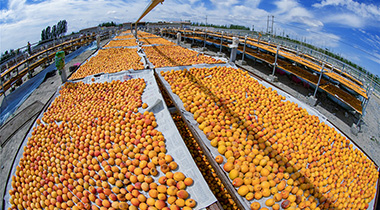
Fruit growing has become a distinctive industry in southern Xinjiang. Walnuts, dates, pomegranates and cherries are all bring in revenues. The forestry and fruit industry now accounts for approximately 25 percent of the local farmers’ per capita net income.
Celebrating the Lantern Festival in a Nursing Home
Photo by Zhao Gang
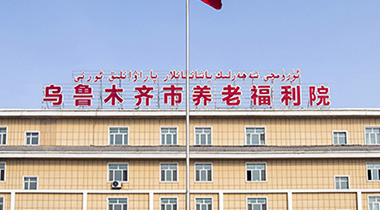
In the Urumqi Municipal Welfare Center well-decorated for the Lantern Festival, the elderly and the staff are singing and laughing together. During the 13th Five-Year Plan period (2016-2020), Xinjiang had preliminarily established an elderly care system integrating home-based, community-based and institution-based services, forging a new model that directly connects elderly care with medical services.
Swinging
Photo by Fu Rui
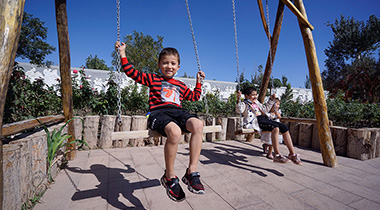
Children are enjoying themselves on the swings in Xiangfei Park, Kashgar City. This park, as a renowned tourist attraction and a key historical and cultural site under national-level protection, showcases the cultural exchange and integration between the central and the northwestern regions in China.
A Relocation Site
Photo by Han Shuanzhu
Since 2017, nearly 14,000 people have been relocated from remote areas of the Kunlun Mountains to Aktashi Town, Yecheng County, Kashgar Prefecture. In contrast to the backwardness, difficulty and dangers in the depth of mountains, the new residential area presents a beautiful landscape.
Green Project for Ecological Protection
Photo by Dou Weibing
Shuixigou Town in Urumqi County has developed an ecological agriculture system. Growing season is extended in the greenhouses with electric heating from carbon fiber panels. Through the development of such ecological projects as well as distinctive industries such as forestry, fruit growing and eco-tourism, the region is turning its natural resources into wealth.
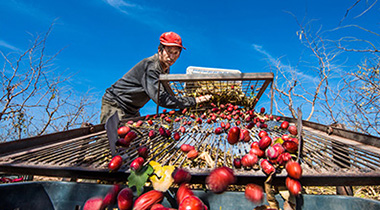
Pomegranate Harvest
Photo by Adil Nadir
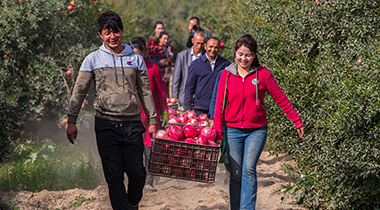
Local farmers carry pomegranates freshly-picked in Hotan Prefecture. Of all the businesses, forestry and fruit growing have substantially increased farmers’ income, thus benefiting the largest number of people in Xinjiang.
Large-Scale Relocation
Photo by Sun Guofu
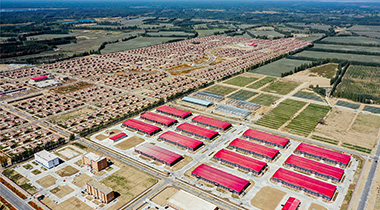
A residential area built under a poverty-alleviation project in Hotan Prefecture has taken shape. 4,123 relocated households now have their new homesteads and the children are enjoying themselves on their new playground. By attracting leading enterprises and developing businesses of planting and livestock farming, this relocation site has laid a solid foundation for its residents to shake off poverty.
Dream of High-Speed Rail
Photo by Wang Qi
With a total length of 1,776 kilometers, the Lanzhou-Xinjiang High-speed Railway is the world’s longest high-speed railway line built under a single project. Since its start of operation in 2014, it has greatly facilitated travel in northwest China.
Night View of the Oilfield
Photo by Shen Jiuquan
Dushanzi Petrochemical, located to the north of Tianshan Mountains, is a primary subsidiary of China National Petroleum Corporation and a key petrochemical base in northwest China. Being among the three earliest oilfields operational in China, Dushanzi is one birthplace of Chinese petroleum industry.
E-commerce in Support of Farmers
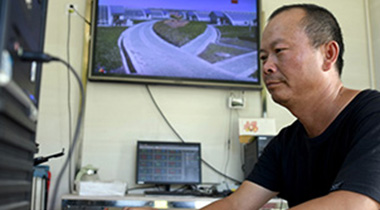
Photo by Guo Jianshe
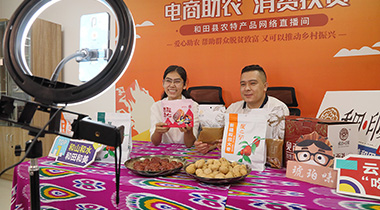
With live-streaming, employees of an e-commerce business sell local agricultural products at the Hotan Walnut Trading Center. E-commerce has been evolving, going from traditional online stores to new modes such as live-streaming on short video platforms such as Taobao Live, Kuaishou and Douyin (Tik Tok).
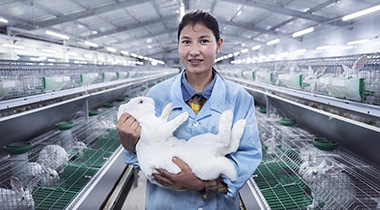
Raising Rabbits for Riches
Photo by Li Xinzhao
Raising rabbits has become a feature industry for farmers and herders in Suyalangan Village, Hotan City to increase their incomes and shake off poverty. In 2019, more than 15 million rabbits were raised in Hotan, increasing the annual incomes of every rabbit-raising household by 12,000 to 16,000 RMB yuan on average.
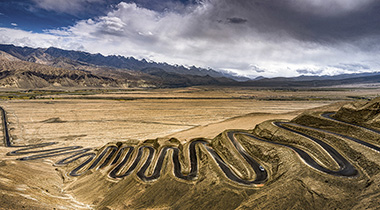
Mountain Road
Photo by Zhao Jianguo
Passing through the mountains of Kashgar Prefecture, the newly built Wugeyati Highway has made travel much easier for the herders on Pamirs Plateau. Though only 36 kilometers in length, it is located at altitude of over 4,200 meters and has more than 600 bends, thus known as the “sky road on the plateau.”
Golden Harvest
Photo by Cui Li
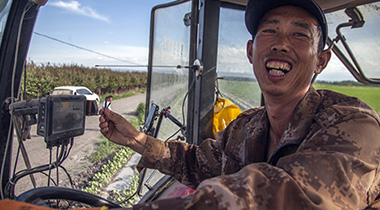
Members of the Xinjiang Production and Construction Corps (XPCC) use heavy machinery to transport corn after a bumper harvest. For more than 60 years, generations of XPCC members have made great contributions to the economic and social development of Xinjiang.
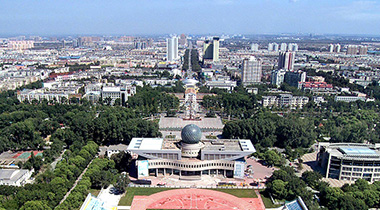
40 Years of Changes in Pictures
Photo by Wang Jianjun and Han Mingxin
Shihezi has been a model city initially built by the army posted to this distant place. The Shihezi Recreation Square was designed and constructed over the land reclaimed from Gobi Desert in 1984. After 30 years, it now covers an area of 24.13 hectares and has become a tree-lined place for residents to relax and exercise.
Harvest Year
Photo by Zhao Dengwen
In 2020, a year of bumper harvest, the grain output in Xinjiang reached 15.83 million tons and cotton output totaled 5.16 million tons.
Blue River
Photo by Ma Songjiang
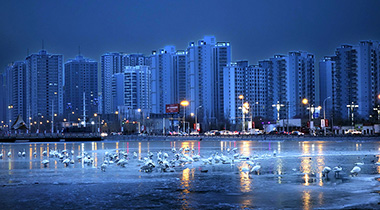
The Dujuan River which flows through Korla City, is now a beautiful habitat for swans. As the local environment is getting better and better, the city is known for the overwintering swans here.
Automated Cotton Planting
Photo by Wang Zilin
Thanks to the mechanization in cotton planting and harvesting as well as the large-scale rural land-use rights transfer, farmers in Xinjiang now rejoice at their increased incomes. As the largest cotton planting area in China, Xinjiang covers to 87 percent of the national cotton output. In 2020, 70 percent of the cotton in Xinjiang was harvested with machine.
Operation of Drones
Photo by Zhang Zhongyi
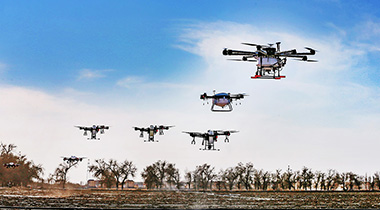
The use of drones has greatly improved cotton planting efficiency. As one major cotton-growing area in Xinjiang, Shihezi City has placed a strong focus on developing agriculture with the help of science and technology.
Land of Peppers
Photo by Gao Shuguang
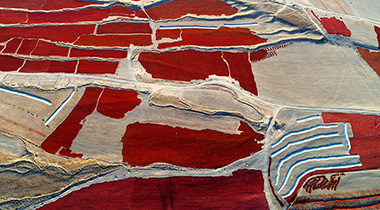
The red pepper fields of Anjihai Town, Tacheng Prefecture are alight in the harvest season. The town has become the largest red pepper trading and distribution center in Xinjiang. The peppers, some of which are sold overseas, contribute to 70 percent of local farmers’ income, making their lives more and more prosperous.
Large New Houses
Photo by Lu Xianyi
The decoration of living rooms in traditional Uygur houses is generally elaborate. The upper part of the walls is embellished with decorative patterns in plaster or with hand-carved wood reaching up to the painted ceilings. There are also tapestries draped on walls and colorful carpets laid over the floors.
Green Scenery
Photo by Li Tao
Aksu Prefecture has been implementing greening projects since 1986. A total of 670,000 volunteers have participated in the planting of 3.9 million trees, reversing desertification of nearly 40,000 square kilometers of land.
A World of Lavender
Photo by Lai Yuning
The northern side of Tianshan Mountains is the largest lavender growing area in China and the third largest one in the world. The lavender business has also boosted local tourism and thus contributed to the overall economic growth across the region.
Moon above Tianshan Mountains
Photo by Han Shuanzhu
Tianshan Mountains, stretching for 1,700 kilometers across northwest China, is a well-known tourist attraction included in the UNESCO World Heritage list. To the north of the mountains lies the most developed area of Xinjiang essential to the development of northwest China.
Night in the Desert
Photo by Li Xueliang
Night view of the deserts in Xinjiang can evoke feelings of mystery and wonder. The soft undulating lines of dunes become clear under the moonlight, enticing visitors to step in and explore.
Autumn Lake Scenery
Photo by Li Xueliang
Kanas Lake and its surrounding areas on the south side of the Altai Mountains have been the homeland of many nomadic ethnic groups since ancient times. With beautiful scenery and lush forests, it stands as a valuable natural and cultural heritage.
Kongur Tiube Peak
Photo by Li Xueliang
The Kongur Tiube Peak of the Kunlun Mountains, standing 7,530 meters above sea level, is perennially covered with snow, like a hat worn by a herdsman. For this reason, local herders call it “Kongur Tiube”, meaning a white hat.
Ancient City of Kashgar
Photo by Wang Zhengui
In history, the Ancient City of Kashgar, as one of the 36 kingdoms in western China, used to have the name of Shule. It was also among “the four garrison commands of Anxi”. Once a business hub on the ancient Silk Road, it has always been the largest city in southern Xinjiang as well as a center for exchanges between the Eastern and Western civilizations.
Splendid Autumn
Photo by Adil Nadir
Located in Hotan County of southern Xinjiang, the Moyu River Valley boasts picturesque sceneries. Originating in the Karakoram Range, the river has a total length of 808 kilometers. It was named for the local production of Moyu, which means black jade.
Highway in the Desert
Photo by Adil Nadir
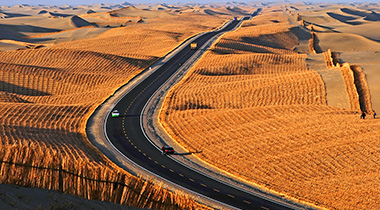
The Tarim Desert Highway is the world’s longest road built on a moving desert. Until its completion, the north and south parts of Xinjiang had been separated by deserts since ancient times. The highway now enables easy transportation and facilitates cultural exchanges.
The Beautiful Bagua City
Photo by Qin Jie
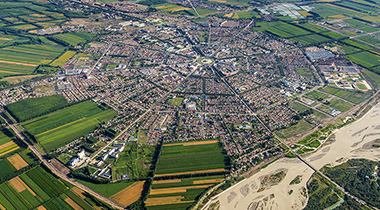
Bagua City in Tekes County, Ili River Valley was established in 1937. Thanks to its shape of “Bagua”, i.e., “Eight Diagrams” formerly used in divination, all traffic lights have been removed from the streets since 1996.
Sky Road
Photo by Xia Quan
The building of Guozigou Bridge on the Lianyungang-Khorgos Expressway in Ili Prefecture was an important project to improve the well-being of the Xinjiang people. Surrounded by clouds and mist, this majestic bridge is a key gateway on the new Silk Road connecting China to Central Asia and Europe.
Hemu Village in Morning Sunlight
Photo by Xia Quan
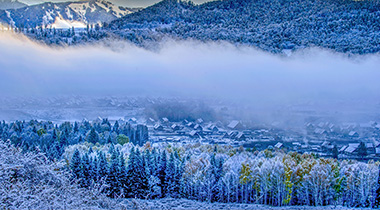
Hemu Village is located by the Kanas Lake in Altay Prefecture. Since ancient times, the nomadic Tuvans have lived in this area. In primitive simplicity, their wooden houses cluster in the tranquil village surrounded by birch forests.
Autumn Wind
Photo by Jiang Luji
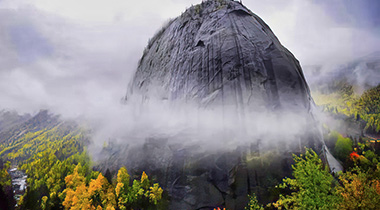
Koktokay National Geological Park in Altay Prefecture boasts a diverse collection of landscapes such as canyons, rivers, wetlands and lakes, as well as rich geological and mineral resources. It has been enlisted as a national 5A-level tourist attraction of China.
Mount Muztagh Ata in Moonlight
Photo by Wu Qiang
Mount Muztagh Atais is located on the east of Pamirs Plateau and the west of Kunlun Mountains. At 7,546 meters above sea level, it is the third highest peak in the western Kunlun Mountains. Its name, Muztag Ata, means “the Father of Ice Mountain” in Uygur language.
The Bridge of Happiness
Photo by Gao Song
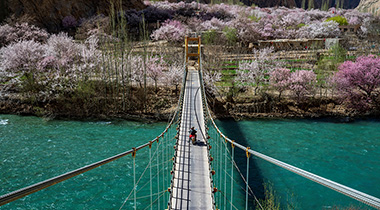
A motorcycle rider is crossing the Xingfu No. 5 Bridge in Tar Tajik Township, Akto County in southern Xinjiang. Local residents with their blossoming apricot present fairyland-like scenery in this Arcadian village.
Dolan Paintings by Farmers
Photo by Han Shuanzhu
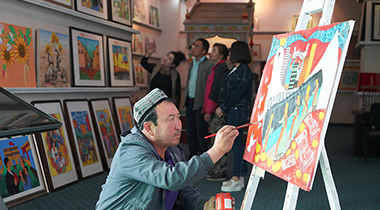
Mukarefujiang Aiheti, a farmer-painter in Hadilek Village produces Dolan paintings, a traditional rural art in Xinjiang. Dolan means “gathering” in the local dialect and Dolan paintings usually depict daily lives of the local people.
Bustling Grand Bazaar
Photo by Sun Guofu
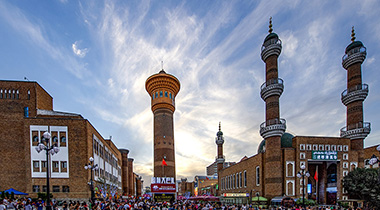
The Xinjiang International Grand Bazaar in Urumqi is the world’s largest Bazaar and attracts tourists from around the globe.
Long Live the Motherland
Photo by Sun Guofu
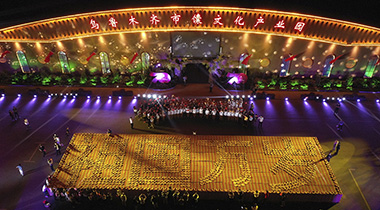
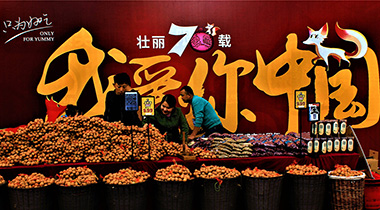
Employees of the Naan Industrial Park in Urumqi City have positioned several thousand naans into the Chinese characters of “Long Live the Motherland.” As the best-known traditional staple in Xinjiang, naan has also become a distinctive symbol of ethnic culture for Xinjiang.
Together We Go for Poverty Alleviation
Photo by Li Xiaoqiang
Online promotion is driving walnut sales to the four corners of the country. Live-streaming has become an important part of local farmers’ work to promote their agricultural products.
In a Library
Photo by Lu Xianyi
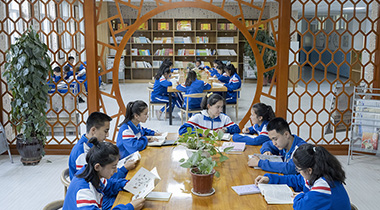
Students are studying in the library of a middle school in Hotan City. It has become a social fashion to advocate the benefit of reading, encourage the youth to enjoy reading and provide them with good books. More and more local teenagers have been attracted to libraries and formed a habit reading and learning.
Wuyi Night Market
Photo by Chen Yu
To Urumqi citizens, visiting night markets is an important part of their life as well as a colorful cultural experience. After the COVID-19 was brought under control in the city, the Wuyi Night Market has been reopened, attracting locals and tourists and bringing considerable income to the vendors.
Football Dream for the Youth
Photo by Zhen Shixin
Campus football, now popular in Xinjiang, brings sunshine and happiness to the youth. A well-known rural football team in Yining County once represented China in an international teenager football game.
Portrait of Beauties
Photo by Lu Xianyi
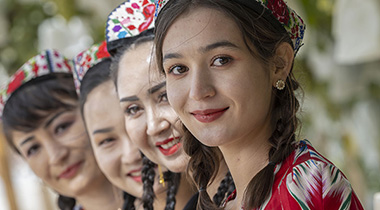
Lasses in ethnic costumes present a beautiful picture in the vineyards of Aksu Prefecture. In addition to a flourishing grape industry, the villagers have developed an “agritainment” business, both of which have increased local employment and incomes.
Heritage of Ethnic Musical Instruments
Photo by Li Ge
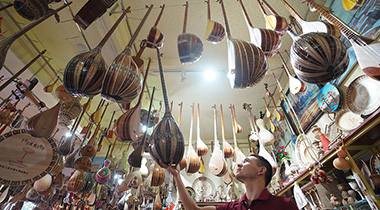
A young man in his traditional musical instrument store in Kashgar Old City. Many of the traditional instruments in Xinjiang are produced in Shufu County of Kashgar Prefecture. The exquisite construction and unique sound of these instruments make them a valued part of the cultural heritage of Xinjiang.
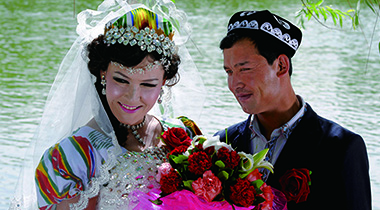
Wedding in Taklimakan
Photo by Sun Guofu
Uygur weddings are elaborate and lively celebrations with rich ethnic features. Families and friends sing and dance together in an atmosphere full of joy.
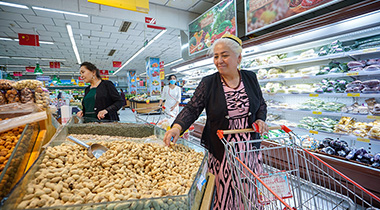
A Great Variety of Goods
Photo by Fu Rui
Local residents are shopping in a supermarket in Kashgar City. Kashgar is the second largest special economic zone in Xinjiang. It also has the name of “the most exotic place” in China.
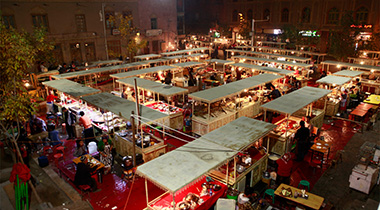
Night Market of Kashgar
Photo by Li Yang
The night market of Kashgar is located opposite the east gate of Kashgar Old City. Home to an endless variety of stalls, it offers a miniature of the vibrant economic and cultural activities of the city’s nightlife.
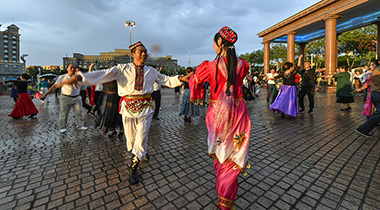
Happy Life in Dances
Photo by Sun Xiang
Locals congregate in the squares, singing and dancing to traditional songs. The people of Xinjiang are well-known throughout China for their talent for singing and dancing.
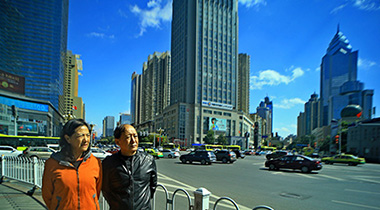
Great Changes
Photo by Li Ming
Here are two pictures of a couple on the Urumqi West Bridge with 33 years in between, showing how much the city has developed since the start of reform and opening-up in 1978. This bridge, connecting areas across the Urumqi River and bearing witness to the passing of the times, is loaded with the memories of several generations.