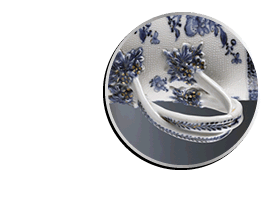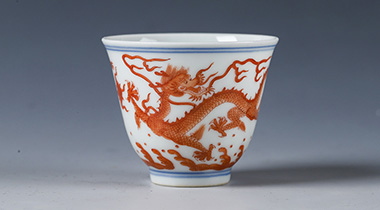

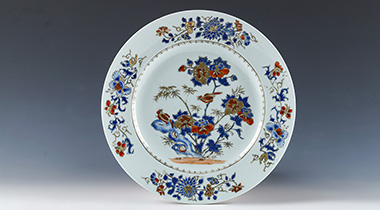
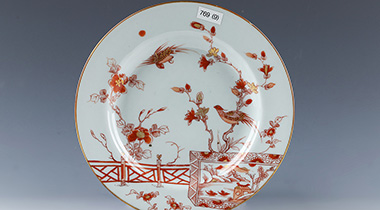

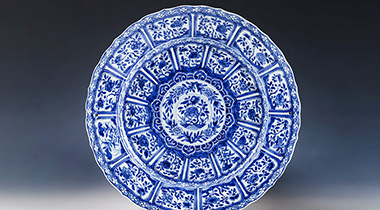

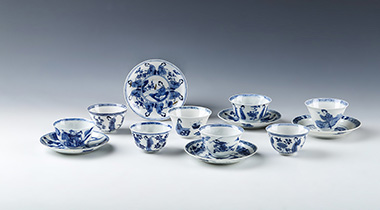






Cup with Design of Dragon in Iron Red in Guangxu Reign of Qing Dynasty (1875-1908)
Craftsmanship: Overglaze Decoration ( Iron Red Painting)
Category: Porcelain for Daily Use Dimensions: 6cm in diameter at mouth, 7cm in height
Collected by New Youth Hutian Ceramic Community of Jingdezhen
Introduction: The dragon is an auspicious animal in the legends of ancient China. It is also the oldest totem in Chinese culture. With auspicious meaning, the image of the dragon appears on a great number and variety of arts and crafts. In the Ming and Qing dynasties, dragons were a revered symbol of the imperial family, embodying a strict social hierarchy. This cup with a design of a dragon in iron red and gold has a fine shape and glaze. The exterior is painted in iron red with a pair of dragons flying over cliffs and ocean while chasing flaming pearls. On the bottom are six characters written in blue in regular script (kaishu, one of China’s major calligraphic forms) that read “Crafted during the Guangxu Reign of the Great Qing Dynasty.” The composition and patterns were designed in strict accordance with the standards set by the Qing court. As a symbol of power and majesty, the dragons have sharp fangs, five claws on each foot, erect hair, and waving bodies. With standard shape, fine glaze, delicate painting in iron red, and neat inscriptions, this cup is an excellent piece crafted by the imperial kiln in Jingdezhen during the Guangxu Reign of the Qing Dynasty.
Written by ZHANG Chen
Category: Porcelain for Daily Use Dimensions: 6cm in diameter at mouth, 7cm in height
Collected by New Youth Hutian Ceramic Community of Jingdezhen
Introduction: The dragon is an auspicious animal in the legends of ancient China. It is also the oldest totem in Chinese culture. With auspicious meaning, the image of the dragon appears on a great number and variety of arts and crafts. In the Ming and Qing dynasties, dragons were a revered symbol of the imperial family, embodying a strict social hierarchy. This cup with a design of a dragon in iron red and gold has a fine shape and glaze. The exterior is painted in iron red with a pair of dragons flying over cliffs and ocean while chasing flaming pearls. On the bottom are six characters written in blue in regular script (kaishu, one of China’s major calligraphic forms) that read “Crafted during the Guangxu Reign of the Great Qing Dynasty.” The composition and patterns were designed in strict accordance with the standards set by the Qing court. As a symbol of power and majesty, the dragons have sharp fangs, five claws on each foot, erect hair, and waving bodies. With standard shape, fine glaze, delicate painting in iron red, and neat inscriptions, this cup is an excellent piece crafted by the imperial kiln in Jingdezhen during the Guangxu Reign of the Qing Dynasty.
Written by ZHANG Chen
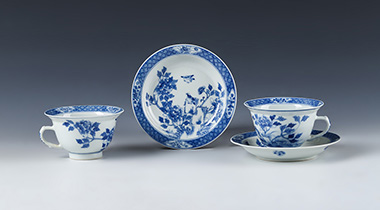
A Set of Cup and Saucer with Design of Flowers and Birds in Blue and White in Guangxu Reign of Qing Dynasty (1875-1908)
Craftsmanship: Underglazed Cobalt Blue Decoration (Blue and White)
Category: Porcelain for Daily Use
Dimensions of the cup: 9 cm in diameter at mouth, 5.5 cm in height Dimensions of the saucer: 12.6 cm in diameter, 7 cm in diameter at foot
Collected by New Youth Hutian Ceramic Community of Jingdezhen
Introduction: The saucer has a flared rim, round foot, and shallow basin. The bottom is glazed white with an apocryphal mark reading “Crafted during the Kangxi Reign.” The rim of the interior wall features a patterned band with floral designs in reserved panels. The interior bottom is painted with stones, peonies, and a kind of bird called a Chinese bulbul, symbolic of couples’ wishes to live to an old age in conjugal bliss. One bird stands on a branch with blooming peonies outlined in blue, while looking up as the other bird flies overhead. The ornamentation is done in refined brushwork and gradations of blue color, and arranged with orderly variations of negative and positive space. The cup has a folded rim, a curved handle, and patterns the same as the saucer.
Both the porcelain bodies and the paintings are brilliant examples of the work of private kilns during the Guangxu Reign. The design shows that people in the late Qing desired to reproduce the style of blue and white porcelain that was crafted during the Kangxi Reign at the beginning of the dynasty. The pattern on this set of cup and saucer has been passed down and developed through many generations. It was used in porcelain products made by Jiangxi Porcelain Company in the Qing Dynasty and also the copies of the Jianguo Porcelain by the porcelain factories after the founding of the People’s Republic of China. Many contemporary porcelain manufacturers still learn to produce this kind of pattern.
Written by QIU Xiaoxin
Category: Porcelain for Daily Use
Dimensions of the cup: 9 cm in diameter at mouth, 5.5 cm in height Dimensions of the saucer: 12.6 cm in diameter, 7 cm in diameter at foot
Collected by New Youth Hutian Ceramic Community of Jingdezhen
Introduction: The saucer has a flared rim, round foot, and shallow basin. The bottom is glazed white with an apocryphal mark reading “Crafted during the Kangxi Reign.” The rim of the interior wall features a patterned band with floral designs in reserved panels. The interior bottom is painted with stones, peonies, and a kind of bird called a Chinese bulbul, symbolic of couples’ wishes to live to an old age in conjugal bliss. One bird stands on a branch with blooming peonies outlined in blue, while looking up as the other bird flies overhead. The ornamentation is done in refined brushwork and gradations of blue color, and arranged with orderly variations of negative and positive space. The cup has a folded rim, a curved handle, and patterns the same as the saucer.
Both the porcelain bodies and the paintings are brilliant examples of the work of private kilns during the Guangxu Reign. The design shows that people in the late Qing desired to reproduce the style of blue and white porcelain that was crafted during the Kangxi Reign at the beginning of the dynasty. The pattern on this set of cup and saucer has been passed down and developed through many generations. It was used in porcelain products made by Jiangxi Porcelain Company in the Qing Dynasty and also the copies of the Jianguo Porcelain by the porcelain factories after the founding of the People’s Republic of China. Many contemporary porcelain manufacturers still learn to produce this kind of pattern.
Written by QIU Xiaoxin
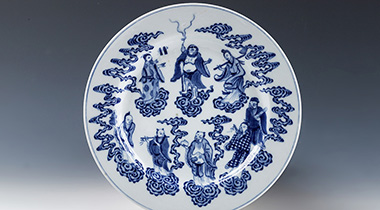
Plate with the Eight Immortals in Blue and White in Jiaqing Reign of Qing Dynasty (1796-1820)
Craftsmanship: Underglaze Cobalt Blue Decoration (Blue and White)
Category: Ornamental Porcelain
Dimensions: 24cm in diameter, 13.5 in diameter at foot
Collected by New Youth Hutian Ceramic Community of Jingdezhen
Introduction: This plate depicts the legendary story of the Eight Immortals Crossing the Sea, which was first recounted in a drama created in the Yuan Dynasty. In the story, eight Taoist Immortals had to travel across the sea to get back home after a feast. One of them suggested that instead of crossing the sea by boat, they could each do so using their own magical powers, to which the other seven agreed.
This piece vividly depicts the Eight Immortals, with detailed facial expressions and their distinctive magical powers. The one in the middle of the upper row is Li Tieguai, leaning on his walking stick and looking to his left, seemingly in conversation with someone. The base of the plate is decorated with fairy cranes flying through auspicious clouds, typical symbols with auspicious meaning in Taoism. Enclosed within two circles on the base are six Chinese characters reading “Crafted during the Xuande Reign of the Great Ming Dynasty”, which is an apocryphal mark written to commemorate the Ming Dynasty which reigned before the Qing.
Written by WANG Lingchuan
Category: Ornamental Porcelain
Dimensions: 24cm in diameter, 13.5 in diameter at foot
Collected by New Youth Hutian Ceramic Community of Jingdezhen
Introduction: This plate depicts the legendary story of the Eight Immortals Crossing the Sea, which was first recounted in a drama created in the Yuan Dynasty. In the story, eight Taoist Immortals had to travel across the sea to get back home after a feast. One of them suggested that instead of crossing the sea by boat, they could each do so using their own magical powers, to which the other seven agreed.
This piece vividly depicts the Eight Immortals, with detailed facial expressions and their distinctive magical powers. The one in the middle of the upper row is Li Tieguai, leaning on his walking stick and looking to his left, seemingly in conversation with someone. The base of the plate is decorated with fairy cranes flying through auspicious clouds, typical symbols with auspicious meaning in Taoism. Enclosed within two circles on the base are six Chinese characters reading “Crafted during the Xuande Reign of the Great Ming Dynasty”, which is an apocryphal mark written to commemorate the Ming Dynasty which reigned before the Qing.
Written by WANG Lingchuan
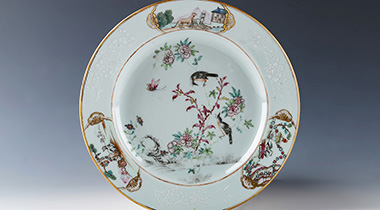
Plate with Flower and Bird Design in Famille-rose and Trailing in Qianlong Reign of Qing Dynasty (1736-1795)
Craftsmanship: Overglaze Decoration (Famille Rose)
Category: Ornamental Porcelain
Dimensions: 23 cm in diameter, 12.5 cm in diameter at foot
Collected by New Youth Hutian Ceramic Community of Jingdezhen
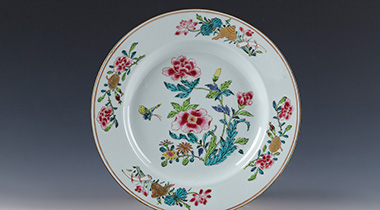
Introduction: This famille-rose plate was produced in Jingdezhen for export to Europe in the 18th century. The center of the plate is decorated with rocks, flowers and birds. Two magpies perch on peony branches, which are calling to one another. A butterfly and a bee fly around the branches, adding to the liveliness of the scene. The decorative pattern on the rim is composed of three individual designs. The three panels on the outer side form a triangle, with the carved flower branch motifs in white slip and oval panels arranged in orderly composition. The designs in the panels on the rim are garden scenes and dogs, sheep and owls, symbolizing loyalty, faith and bravery, respectively. The designs feature distinct European style and symbolic meaning, reflecting the blend of Chinese and Western culture in the decorative designs on exported Jingdezhen porcelain.
Written by WANG Lingchuan
Category: Ornamental Porcelain
Dimensions: 23 cm in diameter, 12.5 cm in diameter at foot
Collected by New Youth Hutian Ceramic Community of Jingdezhen
Introduction: This famille-rose plate was produced in Jingdezhen for export to Europe in the 18th century. The center of the plate is decorated with rocks, flowers and birds. Two magpies perch on peony branches, which are calling to one another. A butterfly and a bee fly around the branches, adding to the liveliness of the scene. The decorative pattern on the rim is composed of three individual designs. The three panels on the outer side form a triangle, with the carved flower branch motifs in white slip and oval panels arranged in orderly composition. The designs in the panels on the rim are garden scenes and dogs, sheep and owls, symbolizing loyalty, faith and bravery, respectively. The designs feature distinct European style and symbolic meaning, reflecting the blend of Chinese and Western culture in the decorative designs on exported Jingdezhen porcelain.
Written by WANG Lingchuan
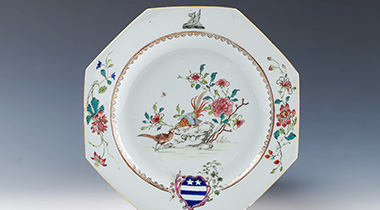
Armorial Plate with Pheasant and Peony in Famille Rose in Qianlong Reign of Qing Dynasty (1736-1795)
Craftsmanship: Overglaze Decoration (Famille Rose)
Category: Ornamental Porcelain
Dimensions: 22cm in diameter, 12 cm in diameter at foot
Collected by New Youth Hutian Ceramic Community of Jingdezhen
Introduction: The 18th century witnessed the heyday of maritime trade between China and the West. With the establishment of branches of the East India Company in European countries, the demand from European aristocrats for customized Chinese ceramics boomed. This contributed to China’s long-term foreign trade surplus, brought huge profits and drove the exchange of Eastern and Western culture during the period. The export of ceramics became a major channel through which Chinese culture reached the west during the Qing Dynasty. This customized famille-rose plate featured the coat of armorial of the family that ordered its production. Except for the upper and lower badges, the designs are of mountain rocks and flowers painted with traditional Chinese painting techniques. The two pheasants standing on the rocks are portrayed as if fighting and playing, making the picture lively and drawing the viewer into the scene.
Written by WANG Lingchuan
Category: Ornamental Porcelain
Dimensions: 22cm in diameter, 12 cm in diameter at foot
Collected by New Youth Hutian Ceramic Community of Jingdezhen
Introduction: The 18th century witnessed the heyday of maritime trade between China and the West. With the establishment of branches of the East India Company in European countries, the demand from European aristocrats for customized Chinese ceramics boomed. This contributed to China’s long-term foreign trade surplus, brought huge profits and drove the exchange of Eastern and Western culture during the period. The export of ceramics became a major channel through which Chinese culture reached the west during the Qing Dynasty. This customized famille-rose plate featured the coat of armorial of the family that ordered its production. Except for the upper and lower badges, the designs are of mountain rocks and flowers painted with traditional Chinese painting techniques. The two pheasants standing on the rocks are portrayed as if fighting and playing, making the picture lively and drawing the viewer into the scene.
Written by WANG Lingchuan
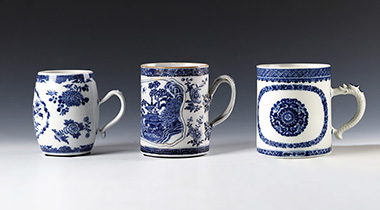
Beer Mug Set in Blue and White in Qianlong Reign of Qing Dynasty (1736-1795)
Craftsmanship: Underglaze Cobalt Blue Decoration (Blue and White)
Category: Porcelains for Daily Use
Collected by New Youth Hutian Ceramic Community of Jingdezhen
Introduction: These Qianlong period beer mugs are constructed in a straight and cylindrical shape. They are glazed in white with shallow, rounded feet, and dragon-shaped and intersected handles on one side. One of the mugs is pasted with a leaf design, which enhances connection with European aesthetics. The mugs are of typical European beer mug styles which were not introduced to China before the Qianlong period. Mugs such as these could be customized based on samples from Europe. The mugs are decorated with blue and white patterns. Despite the different designs depicted on each mug, the decorative styles of each are quite similar with flowers on both the upper and lower sides of the exterior. In the center of each side, delicate designs of flowers, landscapes, and pavilions are painted in panels. These mugs are typical of the beer mugs produced for the European market and each mug integrates the styles of traditional Chinese paintings and European aesthetics at that time, demonstrating the integration of Chinese and Western cultures in the 18th century through the Maritime Silk Route.
Written by QIU Xiaoxin
Category: Porcelains for Daily Use
Collected by New Youth Hutian Ceramic Community of Jingdezhen
Introduction: These Qianlong period beer mugs are constructed in a straight and cylindrical shape. They are glazed in white with shallow, rounded feet, and dragon-shaped and intersected handles on one side. One of the mugs is pasted with a leaf design, which enhances connection with European aesthetics. The mugs are of typical European beer mug styles which were not introduced to China before the Qianlong period. Mugs such as these could be customized based on samples from Europe. The mugs are decorated with blue and white patterns. Despite the different designs depicted on each mug, the decorative styles of each are quite similar with flowers on both the upper and lower sides of the exterior. In the center of each side, delicate designs of flowers, landscapes, and pavilions are painted in panels. These mugs are typical of the beer mugs produced for the European market and each mug integrates the styles of traditional Chinese paintings and European aesthetics at that time, demonstrating the integration of Chinese and Western cultures in the 18th century through the Maritime Silk Route.
Written by QIU Xiaoxin
A series of Porcelain Cups and Saucers with Landscape Designs in Blue and White in Qianlong Reign of Qing Dynasty (1736-1795)
Craftsmanship: Underglaze Cobalt Blue Decoration (Blue and White)
Category: Porcelain for Daily Use
Collected by New Youth Hutian Ceramic Community of Jingdezhen
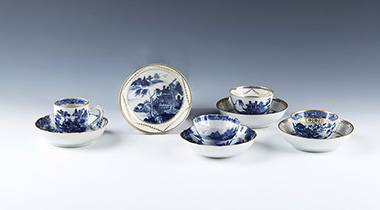
Introduction: These cups and saucers are outstanding among porcelain of the same kind made during the Qianlong period. The rims of the interior walls have patterned bands. The exquisite paintings in blue on the white background present the landscape and architecture of ancient China, which mainly includes houses, pavilions, pagodas, bridges, willows, lakes, and wild geese. These items exhibit the tranquil style of East Asian pavilions beside mountains and rivers, which were favored by the upper classes in the West in the 18th century. During this period, designs such as these exerted the greatest influence on the world’s porcelain production, were most popular in Europe and were produced in the greatest volume. Porcelain of this style was known as Nanking Pattern porcelain in Europe and later as Willow Pattern porcelain. In Europe, the pattern was imitated on Meissen porcelain produced in Germany, which was Europe’s first hard-paste porcelain. In China, this style of porcelain developed throughout the late Qing Dynasty and the Republic of China period, and was still produced on a large scale by Jingdezhen People’s Porcelain Factory after the founding of the People’s Republic of China in 1949. It is a classic design based on the integration of Eastern and Western aesthetics that was popular in the world for more than 200 years.
Written by QIU Xiaoxin
Category: Porcelain for Daily Use
Collected by New Youth Hutian Ceramic Community of Jingdezhen
Introduction: These cups and saucers are outstanding among porcelain of the same kind made during the Qianlong period. The rims of the interior walls have patterned bands. The exquisite paintings in blue on the white background present the landscape and architecture of ancient China, which mainly includes houses, pavilions, pagodas, bridges, willows, lakes, and wild geese. These items exhibit the tranquil style of East Asian pavilions beside mountains and rivers, which were favored by the upper classes in the West in the 18th century. During this period, designs such as these exerted the greatest influence on the world’s porcelain production, were most popular in Europe and were produced in the greatest volume. Porcelain of this style was known as Nanking Pattern porcelain in Europe and later as Willow Pattern porcelain. In Europe, the pattern was imitated on Meissen porcelain produced in Germany, which was Europe’s first hard-paste porcelain. In China, this style of porcelain developed throughout the late Qing Dynasty and the Republic of China period, and was still produced on a large scale by Jingdezhen People’s Porcelain Factory after the founding of the People’s Republic of China in 1949. It is a classic design based on the integration of Eastern and Western aesthetics that was popular in the world for more than 200 years.
Written by QIU Xiaoxin
A Set of Oval Porcelain Plates with Fitzhugh Design in Blue and White in Qianlong Reign of Qing Dynasty (1736-1795)
Craftsmanship: Underglaze Cobalt Blue Decoration (Blue and White)
Category: Porcelain for Daily Use
Dimensions: 25.5cm (S), 29cm (M) and 36cm (L) in length
Collected by New Youth Hutian Ceramic Community in Jingdezhen
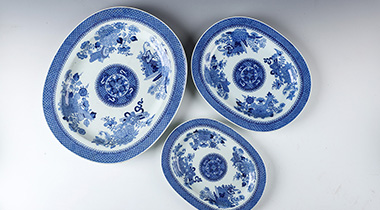
Introduction: This set of blue and white porcelain plates are exquisite pieces produced by private kilns for the foreign market during the Qianlong Reign of the Qing Dynasty. The three oval plates can be stacked and can be used in everyday life or for decoration. They have flared rims, flat bases, and shallow, arced sides. The rims are decorated with patterned bands. The interior walls are painted with various types of flowers, such as peonies, surrounding an auspicious pattern. The regularity of the shape and design of the patterns are complemented by the lustrous finish of the glaze and the depth of the blue color. All the patterns are painted with high-quality pigments of the time. These plates are typical Fitzhugh pattern porcelains. The Fitzhugh pattern was first designed in the 1760s by Thomas Fitzhugh, then director of Guangzhou administrative office of the East India Company. With a blend of Chinese and Western styles, this pattern was usually used in Armorial porcelain. The traditional Chinese patterns with auspicious meanings attracted consumers in Western countries, who were fascinated by the mysteries of Chinese culture, while the composition using Western design methods also catered to foreign markets. Therefore, the Fitzhugh design was greatly used on ornamental porcelain of various kinds for export to Europe and America until the 19th century.
Written by QIU Xiaoxin
Category: Porcelain for Daily Use
Dimensions: 25.5cm (S), 29cm (M) and 36cm (L) in length
Collected by New Youth Hutian Ceramic Community in Jingdezhen
Introduction: This set of blue and white porcelain plates are exquisite pieces produced by private kilns for the foreign market during the Qianlong Reign of the Qing Dynasty. The three oval plates can be stacked and can be used in everyday life or for decoration. They have flared rims, flat bases, and shallow, arced sides. The rims are decorated with patterned bands. The interior walls are painted with various types of flowers, such as peonies, surrounding an auspicious pattern. The regularity of the shape and design of the patterns are complemented by the lustrous finish of the glaze and the depth of the blue color. All the patterns are painted with high-quality pigments of the time. These plates are typical Fitzhugh pattern porcelains. The Fitzhugh pattern was first designed in the 1760s by Thomas Fitzhugh, then director of Guangzhou administrative office of the East India Company. With a blend of Chinese and Western styles, this pattern was usually used in Armorial porcelain. The traditional Chinese patterns with auspicious meanings attracted consumers in Western countries, who were fascinated by the mysteries of Chinese culture, while the composition using Western design methods also catered to foreign markets. Therefore, the Fitzhugh design was greatly used on ornamental porcelain of various kinds for export to Europe and America until the 19th century.
Written by QIU Xiaoxin
Plate with Peony and Rock Design in Blue and White in Qianlong Reign of Qing Dynasty (1736-1795)
Craftsmanship: Underglaze Cobalt Blue Decoration (Blue and White)
Category: Ornamental Porcelain
Dimensions: 24 cm in diameter, 13 cm in diameter at foot
Collected by New Youth Hutian Ceramic Community of Jingdezhen
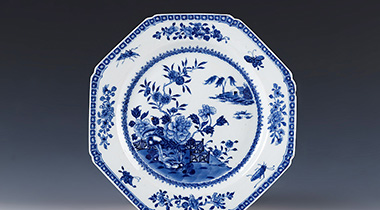
Introduction: This blue and white plate was made in Jingdezhen kilns for export during the Qianlong period and features an elegant and graceful style. The plate is octagonal in shape with a folded rim that is decorated with an orderly composition of flowers on cut stems and insects using underglaze blue. The detailed depiction of the subjects showcases the superb skills of the craftsmen of the Jingdezhen kilns and the high level of development of the ceramic manufacturing industry in Jingdezhen during this period. The design in the center of the plate is of peonies and rocks in the foreground, with mountains in the distance. The designs present a beautiful spring scene in the river regions of eastern China.
Written by FU Dan
Category: Ornamental Porcelain
Dimensions: 24 cm in diameter, 13 cm in diameter at foot
Collected by New Youth Hutian Ceramic Community of Jingdezhen
Introduction: This blue and white plate was made in Jingdezhen kilns for export during the Qianlong period and features an elegant and graceful style. The plate is octagonal in shape with a folded rim that is decorated with an orderly composition of flowers on cut stems and insects using underglaze blue. The detailed depiction of the subjects showcases the superb skills of the craftsmen of the Jingdezhen kilns and the high level of development of the ceramic manufacturing industry in Jingdezhen during this period. The design in the center of the plate is of peonies and rocks in the foreground, with mountains in the distance. The designs present a beautiful spring scene in the river regions of eastern China.
Written by FU Dan
Plate with Characters and Story Design in Blue and White and Famille-rose in Qianlong Reign of Qing Dynasty (1736-1795)
Craftsmanship: Overglaze Decoration, Underglaze Decoration
Category: Ornamental Porcelain
Dimensions: 23 cm in diameter, 12 cm in diameter at foot
Collected by Jingdezhen Qing Art Museum
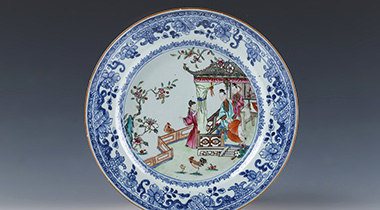
Introduction: This work is porcelain of the traditional Chinese style exported to Europe in the 18th century. It is an example of the exquisite products that were traded between the East and West through the Ancient Maritime Silk Route. The plate has a folded rim with a brown-glazed edge that is decorated with a blue and white pattern of flowers on twining branches. In the center of the plate is a painting of human figures in famille rose. After the famille rose pigment was applied, the porcelain was fired for a second time. The decoration on the rim of this plate was common in pieces exported from Jingdezhen kilns in the 18th century. The design is a result of the blending of Chinese and Western aesthetics through exchange and trade, which brought the Rococo style that prevailed in Europe at the time together with the pattern of flowers on twining branches that was popular during the Qianlong period. This blending generated a unique design style in exported porcelains of the period. The design in the center depicts part of the plot from The Story of the Western Wing, a romance written in the 13th century. It conveys young people’s desire for freedom in love during the time of China’s rigid feudal code of conduct, and also the hope for all lovers to be together. This plate is an important artifact not only for its artistic merit, but also for the insight it gives into ancient Chinese literature and culture.
Written by LV Ziqing
Category: Ornamental Porcelain
Dimensions: 23 cm in diameter, 12 cm in diameter at foot
Collected by Jingdezhen Qing Art Museum
Introduction: This work is porcelain of the traditional Chinese style exported to Europe in the 18th century. It is an example of the exquisite products that were traded between the East and West through the Ancient Maritime Silk Route. The plate has a folded rim with a brown-glazed edge that is decorated with a blue and white pattern of flowers on twining branches. In the center of the plate is a painting of human figures in famille rose. After the famille rose pigment was applied, the porcelain was fired for a second time. The decoration on the rim of this plate was common in pieces exported from Jingdezhen kilns in the 18th century. The design is a result of the blending of Chinese and Western aesthetics through exchange and trade, which brought the Rococo style that prevailed in Europe at the time together with the pattern of flowers on twining branches that was popular during the Qianlong period. This blending generated a unique design style in exported porcelains of the period. The design in the center depicts part of the plot from The Story of the Western Wing, a romance written in the 13th century. It conveys young people’s desire for freedom in love during the time of China’s rigid feudal code of conduct, and also the hope for all lovers to be together. This plate is an important artifact not only for its artistic merit, but also for the insight it gives into ancient Chinese literature and culture.
Written by LV Ziqing
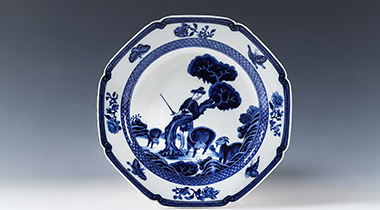
Octagonal Plate with Shepherdess Design in Blue and White in Qianlong Reign of Qing Dynasty (1736-1795)
Craftsmanship: Underglaze Cobalt Blue Decoration (Blue and White)
Category: Ornamental Porcelain
Dimensions: 22 cm in diameter, 13 cm in diameter at foot
Collected by New Youth Hutian Ceramic Community of Jingdezhen
Introduction: This blue and white plate was made in Jingdezhen for export during the Qianlong period and features an elegant and graceful style. The plate is octagonal in shape, with a folded rim that is decorated with an orderly composition of butterflies and flowers on cut stems in underglaze blue. The detailed depiction of the subjects showcases the superb skills of the craftsmen of the Jingdezhen kilns and the high level of development of the ceramic manufacturing industry in Jingdezhen during this period. The design in the center of the plate, featuring a shepherdess, is an excellent example of the blending of the traditional Chinese painting style, which focuses on line drawing and the use of empty space, and the Western style, which focuses on shading and the contrast between light and dark. The plate’s brilliant blue color and distinct hues and shades make it a masterpiece of the blue and white export porcelain in the Qianlong period.
Written by FU Dan
Category: Ornamental Porcelain
Dimensions: 22 cm in diameter, 13 cm in diameter at foot
Collected by New Youth Hutian Ceramic Community of Jingdezhen
Introduction: This blue and white plate was made in Jingdezhen for export during the Qianlong period and features an elegant and graceful style. The plate is octagonal in shape, with a folded rim that is decorated with an orderly composition of butterflies and flowers on cut stems in underglaze blue. The detailed depiction of the subjects showcases the superb skills of the craftsmen of the Jingdezhen kilns and the high level of development of the ceramic manufacturing industry in Jingdezhen during this period. The design in the center of the plate, featuring a shepherdess, is an excellent example of the blending of the traditional Chinese painting style, which focuses on line drawing and the use of empty space, and the Western style, which focuses on shading and the contrast between light and dark. The plate’s brilliant blue color and distinct hues and shades make it a masterpiece of the blue and white export porcelain in the Qianlong period.
Written by FU Dan
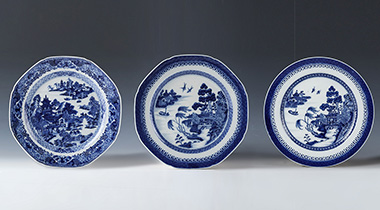
Plate with Landscape Design in Blue and White in Qianlong Reign of Qing Dynasty (1736-1795)
Craftsmanship: Underglaze Cobalt Blue Decoration (Blue and White)
Category: Ornamental Porcelain
Dimensions: 23.5-24.5 cm in diameter, 13-14cm in diameter at foot
Collected by New Youth Hutian Ceramic Community of Jingdezhen
Introduction: These three blue and white plates are decorated with landscape designs in the Qianlong period. Each of the designs is different (two slightly so) but all are in the same style. The designs are composed of houses, buildings, gatehouses, pavilions, towers, bridges, willow trees, lakes and wild geese. The blue and white porcelain has brilliant color and lustrous glaze, which makes the pieces stand out from those with similar themes from the same period. It embodies the beauty of Chinese gardens and reflects the admiration for Eastern culture within the upper classes of the West in the 18th century. The three plates are examples of the integration of traditional Chinese design with the lifestyles and aesthetic tastes of European aristocrats at that time, which occurred through the integration of Chinese and Western cultures through the Maritime Silk Route. This style was known in Europe as Nanking Pattern porcelain, and later as Willow Pattern porcelain. In Europe, this decorative pattern was copied by the German-produced Meissen porcelain, with the style remaining in production until now. In China, from the late Qing Dynasty to the Republic of China period, and even after the founding of the People’s Republic of China, porcelain featuring this style of decoration has been produced on a massive scale by the People’s Porcelain Factory in Jingdezhen. It is a classic design based on the integration of Eastern and Western aesthetics that was popular in the world for more than 200 years
Written by QIU Xiaoxin
Category: Ornamental Porcelain
Dimensions: 23.5-24.5 cm in diameter, 13-14cm in diameter at foot
Collected by New Youth Hutian Ceramic Community of Jingdezhen
Introduction: These three blue and white plates are decorated with landscape designs in the Qianlong period. Each of the designs is different (two slightly so) but all are in the same style. The designs are composed of houses, buildings, gatehouses, pavilions, towers, bridges, willow trees, lakes and wild geese. The blue and white porcelain has brilliant color and lustrous glaze, which makes the pieces stand out from those with similar themes from the same period. It embodies the beauty of Chinese gardens and reflects the admiration for Eastern culture within the upper classes of the West in the 18th century. The three plates are examples of the integration of traditional Chinese design with the lifestyles and aesthetic tastes of European aristocrats at that time, which occurred through the integration of Chinese and Western cultures through the Maritime Silk Route. This style was known in Europe as Nanking Pattern porcelain, and later as Willow Pattern porcelain. In Europe, this decorative pattern was copied by the German-produced Meissen porcelain, with the style remaining in production until now. In China, from the late Qing Dynasty to the Republic of China period, and even after the founding of the People’s Republic of China, porcelain featuring this style of decoration has been produced on a massive scale by the People’s Porcelain Factory in Jingdezhen. It is a classic design based on the integration of Eastern and Western aesthetics that was popular in the world for more than 200 years
Written by QIU Xiaoxin
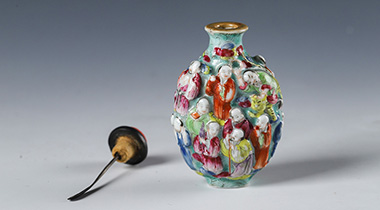
Snuff Bottle with the Eighteen Arhats of Buddhism in Famille-rose in Tongzhi Reign of Qing Dynasty (1862-1874)
Craftsmanship: Integrated Overglaze Decoration (Molding Pressing and Famille Rose)
Category: Porcelain for Daily Use
Dimensions: 5cm in height
Collected by New Youth Hutian Ceramic Community of Jingdezhen
Introduction: Snuff bottles were popularized during the Qianlong Reign of the Qing Dynasty. Snuff-taking was said to be quite refreshing and became a common habit among literati and merchants in the Qing Dynasty. The popularity of snuff boosted the production of snuff bottles during this period. Snuff bottles can be made from a variety of materials, but those with porcelain bodies were the most popular. This famille-rose snuff bottle is decorated with the 18 Arhats of Buddhism. The painting vividly depicts the distinctive facial expressions and postures of the Arhats with delicate stokes and famille-rose colors, making this snuff bottle an excellent example of porcelain ornaments in the late Qing period. In short, this snuff bottle is a miniature masterpiece that represents many features from that period.
Written by WANG Lingchuan
Category: Porcelain for Daily Use
Dimensions: 5cm in height
Collected by New Youth Hutian Ceramic Community of Jingdezhen
Introduction: Snuff bottles were popularized during the Qianlong Reign of the Qing Dynasty. Snuff-taking was said to be quite refreshing and became a common habit among literati and merchants in the Qing Dynasty. The popularity of snuff boosted the production of snuff bottles during this period. Snuff bottles can be made from a variety of materials, but those with porcelain bodies were the most popular. This famille-rose snuff bottle is decorated with the 18 Arhats of Buddhism. The painting vividly depicts the distinctive facial expressions and postures of the Arhats with delicate stokes and famille-rose colors, making this snuff bottle an excellent example of porcelain ornaments in the late Qing period. In short, this snuff bottle is a miniature masterpiece that represents many features from that period.
Written by WANG Lingchuan
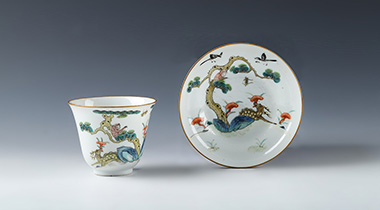
Cup and Saucer with Promotion Design in Famille Rose in Xianfeng Reign of Qing Dynasty (1851-1861)
Category: Porcelain for Daily Use
Dimensions of Cup: 8.7 cm in diameter at mouth, 7cm in height, Dimensions of Saucer: 13cm in diameter
Collected by New Youth Hutian Ceramic Community of Jingdezhen
Introduction: This cup has a flared mouth, round foot and deep sides with white glaze. The rim is outlined in brown glaze. The bottom is inscribed in iron red with the reign mark “Made during the Xianfeng Reign.” The saucer has an open mouth, round foot, and brown-glazed rim. The cup and the saucer are both painted with designs of traditional Chinese patterns in famille rose, a technique known for its use of soft pigments (famille rose). In the painting, two magpies are flying and singing in the sky while a monkey is playing in a pine tree. Under the tree, a deer is holding a lucid ganoderma, a type of wild mushroom prized in Chinese medicine, in its mouth. Also present is a bee buzzing among the flowers. The delicate lines and famille-rose colors make the whole design lively and interesting. In Chinese culture, the green pine tree and lucid ganoderma are symbols of longevity. “Deer” (lu, 鹿), “bee” (feng, 蜂), and “monkey” (hou, 猴) share similar pronunciations with “path” (lu, 路), “confer” (feng, 封) and “nobility” (hou, 侯) in Chinese respectively. In this way, the whole piece implies a smooth path to being promoted and to be conferred with titles of nobility. With delicate painting, a clever design, good quality and auspicious meaning, this cup and saucer set is an exemplary work of private kilns during the Xianfeng Reign (1851-1861).
Written by QIU Xiaoxin
Dimensions of Cup: 8.7 cm in diameter at mouth, 7cm in height, Dimensions of Saucer: 13cm in diameter
Collected by New Youth Hutian Ceramic Community of Jingdezhen
Introduction: This cup has a flared mouth, round foot and deep sides with white glaze. The rim is outlined in brown glaze. The bottom is inscribed in iron red with the reign mark “Made during the Xianfeng Reign.” The saucer has an open mouth, round foot, and brown-glazed rim. The cup and the saucer are both painted with designs of traditional Chinese patterns in famille rose, a technique known for its use of soft pigments (famille rose). In the painting, two magpies are flying and singing in the sky while a monkey is playing in a pine tree. Under the tree, a deer is holding a lucid ganoderma, a type of wild mushroom prized in Chinese medicine, in its mouth. Also present is a bee buzzing among the flowers. The delicate lines and famille-rose colors make the whole design lively and interesting. In Chinese culture, the green pine tree and lucid ganoderma are symbols of longevity. “Deer” (lu, 鹿), “bee” (feng, 蜂), and “monkey” (hou, 猴) share similar pronunciations with “path” (lu, 路), “confer” (feng, 封) and “nobility” (hou, 侯) in Chinese respectively. In this way, the whole piece implies a smooth path to being promoted and to be conferred with titles of nobility. With delicate painting, a clever design, good quality and auspicious meaning, this cup and saucer set is an exemplary work of private kilns during the Xianfeng Reign (1851-1861).
Written by QIU Xiaoxin
Plate with “School Life” Design in Canton Enamel in Xianfeng Reign of Qing Dynasty (1851-1861)
Craftsmanship: Overglaze Decoration (Canton Enamel)
Category: Ornamental Porcelain
Dimensions: 37cm in diameter, 19.5 cm in diameter at foot
Collected by Jingdezhen Qing Art Museum
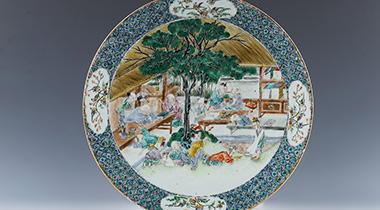
Introduction: This is a rare fine piece of Canton enamel porcelain made during the Xianfeng Reign of the Qing Dynasty. The Canton enamel technique was known for its bright and varied overglazed color pigments and was created mainly for the foreign market. It was very popular in the 18th century. The porcelain trade of the East India Company also greatly increased its production. This large porcelain plate is well preserved. The porcelain body is a fine white piece fired at high temperature in a kiln in Jingdezhen and the painting was completed by a workshop that specialized in overglazed decoration in Guangzhou. The folded rim features a patterned band and four roundels with flower and bird patterns. In the center of the well is a typical painting of folk life titled School life in the cottage. It captures the scene of a teacher taking a nap while naughty children are playing around him. The cottage and the parasol tree in the courtyard are drawn in dark colors to highlight the naughty children in bright colors.
Written by WANG Lingchuan
Category: Ornamental Porcelain
Dimensions: 37cm in diameter, 19.5 cm in diameter at foot
Collected by Jingdezhen Qing Art Museum
Introduction: This is a rare fine piece of Canton enamel porcelain made during the Xianfeng Reign of the Qing Dynasty. The Canton enamel technique was known for its bright and varied overglazed color pigments and was created mainly for the foreign market. It was very popular in the 18th century. The porcelain trade of the East India Company also greatly increased its production. This large porcelain plate is well preserved. The porcelain body is a fine white piece fired at high temperature in a kiln in Jingdezhen and the painting was completed by a workshop that specialized in overglazed decoration in Guangzhou. The folded rim features a patterned band and four roundels with flower and bird patterns. In the center of the well is a typical painting of folk life titled School life in the cottage. It captures the scene of a teacher taking a nap while naughty children are playing around him. The cottage and the parasol tree in the courtyard are drawn in dark colors to highlight the naughty children in bright colors.
Written by WANG Lingchuan
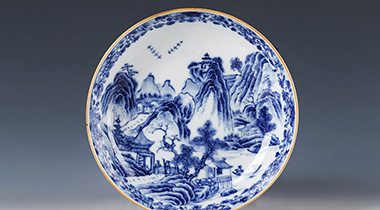
Plate with Landscape and Trailing in Wucai in Yongzheng Reign of Qing Dynasty (1722-1735)
Craftsmanship: Overglaze Decoration (Paste Glossy White, Five colored enamel)
Category: Ornamental Porcelain
Dimensions: 25cm in diameter, 12.5 cm basal diameter
Collected by Jingdezhen Qing Art Museum
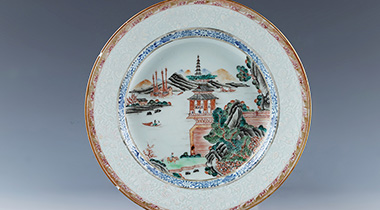
Introduction: This plate was produced in a private kiln in Jingdezhen for export to Europe in the 18th century. The decoration includes multiple techniques including brown overglaze decoration, gilt, paste glossy white motifs and Wucai (five-colored) enamel. The shallow plate with folded rim covered by brown glaze has patterns of flowers on twining stems. The center of the plate paints five-colored scenery of the river regions of eastern China. The design is of a similar style to landscape designs on blue and white porcelain from the same period. The combination of multiple techniques makes the porcelain aesthetically appealing and shows the sophistication of porcelain making and design in the Qianlong period. The landscape design can transport viewers’ imaginations far beyond the plate.
Written by LV Ziqing
Category: Ornamental Porcelain
Dimensions: 25cm in diameter, 12.5 cm basal diameter
Collected by Jingdezhen Qing Art Museum
Introduction: This plate was produced in a private kiln in Jingdezhen for export to Europe in the 18th century. The decoration includes multiple techniques including brown overglaze decoration, gilt, paste glossy white motifs and Wucai (five-colored) enamel. The shallow plate with folded rim covered by brown glaze has patterns of flowers on twining stems. The center of the plate paints five-colored scenery of the river regions of eastern China. The design is of a similar style to landscape designs on blue and white porcelain from the same period. The combination of multiple techniques makes the porcelain aesthetically appealing and shows the sophistication of porcelain making and design in the Qianlong period. The landscape design can transport viewers’ imaginations far beyond the plate.
Written by LV Ziqing
Plate with Children Design in Famille-rose in Yongzheng Reign of Qing Dynasty (1722-1735)
Craftsmanship: Overglaze Decoration (Famille Rose)
Category: Ornamental Porcelain
Dimensions: 22.5 cm in diameter, 11.5 cm in diameter at foot
Collected by New Youth Hutian Ceramic Community of Jingdezhen
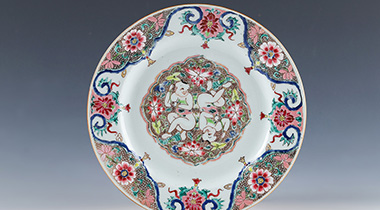
Introduction: This is a rare famille-rose plate in the Yongzheng period that features pure colors and a lustrous finish. On the rim there are pearl-like patterns and flowers on twining branches. The plate demonstrates the perfect fusion of traditional Chinese design style and the European Rococo style of the same period. The center of the plate is embellished with a design of two children holding lotus flowers, which is an auspicious expression of the desire to have more children. Worthy of note is the pattern of the two plump children, placed back to back with one inverted to make the picture seem complete from any perspective. This design was produced by a private kiln in Jingdezhen nearly 300 years ago, however, with the passage of time, it has become impossible to ascertain in which kiln it was made. This outstanding piece not only features vividly designed human figures but also demonstrates the rules of traditional Chinese design and the accumulated knowledge contained within it, as well as providing a lasting expression of ancient Chinese culture.
Written by ZHANG Chen
Category: Ornamental Porcelain
Dimensions: 22.5 cm in diameter, 11.5 cm in diameter at foot
Collected by New Youth Hutian Ceramic Community of Jingdezhen
Introduction: This is a rare famille-rose plate in the Yongzheng period that features pure colors and a lustrous finish. On the rim there are pearl-like patterns and flowers on twining branches. The plate demonstrates the perfect fusion of traditional Chinese design style and the European Rococo style of the same period. The center of the plate is embellished with a design of two children holding lotus flowers, which is an auspicious expression of the desire to have more children. Worthy of note is the pattern of the two plump children, placed back to back with one inverted to make the picture seem complete from any perspective. This design was produced by a private kiln in Jingdezhen nearly 300 years ago, however, with the passage of time, it has become impossible to ascertain in which kiln it was made. This outstanding piece not only features vividly designed human figures but also demonstrates the rules of traditional Chinese design and the accumulated knowledge contained within it, as well as providing a lasting expression of ancient Chinese culture.
Written by ZHANG Chen
A Cup and Saucer with Floral Design in Famille-rose in Yongzheng Reign of Qing Dynasty (1722-1735)
Craftsmanship: Overglaze Decoration (Famille Rose)
Category: Porcelains for Daily Use
Dimensions of Cup: 6cm in diameter at mouth, 5cm in height
Dimensions of Plate: 12cm in diameter Collected by New Youth Hutian Ceramic Community of Jingdezhen
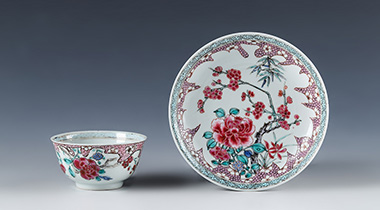
Introduction: In the late Kangxi period (1661-1722), famille-rose porcelain was developed based on the manufacturing techniques used to produce enamel porcelain, which gradually increased in popularity along with blue and white porcelain. The famille-rose technique uses glossy white as a primer before other color pigments are applied, which can create soft transitions between colors and improve the effect of paintings. The manufacturing of famille-rose porcelains peaked during the Yongzheng period, with those made in official and private kilns both featuring high-quality craftsmanship and aesthetic taste. Famille-rose porcelains produced in some private kilns were almost identical to those made in official kilns, with only the marks on the bases being different. This cup and matching saucer, with lustrous finish and pure color, were made in private kilns using the finest materials available. The cup and saucer have panels in the shape of leaves and pearl-like patterns on the rim, highlighting flower designs in the center. The set features delicate brushwork and appealing style, and is a charming and auspicious example of fine porcelain from the private kilns in Jingdezhen during the Yongzheng period.
Written by ZHANG Chen
Category: Porcelains for Daily Use
Dimensions of Cup: 6cm in diameter at mouth, 5cm in height
Dimensions of Plate: 12cm in diameter Collected by New Youth Hutian Ceramic Community of Jingdezhen
Introduction: In the late Kangxi period (1661-1722), famille-rose porcelain was developed based on the manufacturing techniques used to produce enamel porcelain, which gradually increased in popularity along with blue and white porcelain. The famille-rose technique uses glossy white as a primer before other color pigments are applied, which can create soft transitions between colors and improve the effect of paintings. The manufacturing of famille-rose porcelains peaked during the Yongzheng period, with those made in official and private kilns both featuring high-quality craftsmanship and aesthetic taste. Famille-rose porcelains produced in some private kilns were almost identical to those made in official kilns, with only the marks on the bases being different. This cup and matching saucer, with lustrous finish and pure color, were made in private kilns using the finest materials available. The cup and saucer have panels in the shape of leaves and pearl-like patterns on the rim, highlighting flower designs in the center. The set features delicate brushwork and appealing style, and is a charming and auspicious example of fine porcelain from the private kilns in Jingdezhen during the Yongzheng period.
Written by ZHANG Chen
Plate with Floral Design in Famille-rose in Yongzheng Reign of Qing Dynasty (1722-1735)
Craftsmanship: Overglaze Decoration (Famille Rose)
Category: Ornamental Porcelain
Dimensions: 24cm in diameter, 12 cm diameter at foot
Collected by New Youth Hutian Ceramic Community of Jingdezhen
Introduction: This shallow famille-rose plate has a wide rim and round foot. It has white glaze and four flowers painted in iron red on the back without a mark on the base. The rim of the plate is edged in brown glaze and embellished with peonies, lotus flowers, lotus roots pomegranates and conch shells. In the center there is a design of a butterfly flying above flowers, which is a common theme in ancient times that symbolizes love and happiness. With pastel colors, the plate has lustrous glaze and an elegant design. Famille-rose porcelain is one of the four famous types of porcelain made in Jingdezhen. According to A General Introduction of Chinese Ceramics (Tao Ya), a book on porcelain in Qing Dynasty, “famille rose porcelain from the Yongzheng period are the most beautiful ever made and feature brilliant colors.” The plate is a typical famille-rose porcelain of the Yongzheng period in terms of its fine body, glaze, color and craftsmanship.
Written by FU Dan
Category: Ornamental Porcelain
Dimensions: 24cm in diameter, 12 cm diameter at foot
Collected by New Youth Hutian Ceramic Community of Jingdezhen
Introduction: This shallow famille-rose plate has a wide rim and round foot. It has white glaze and four flowers painted in iron red on the back without a mark on the base. The rim of the plate is edged in brown glaze and embellished with peonies, lotus flowers, lotus roots pomegranates and conch shells. In the center there is a design of a butterfly flying above flowers, which is a common theme in ancient times that symbolizes love and happiness. With pastel colors, the plate has lustrous glaze and an elegant design. Famille-rose porcelain is one of the four famous types of porcelain made in Jingdezhen. According to A General Introduction of Chinese Ceramics (Tao Ya), a book on porcelain in Qing Dynasty, “famille rose porcelain from the Yongzheng period are the most beautiful ever made and feature brilliant colors.” The plate is a typical famille-rose porcelain of the Yongzheng period in terms of its fine body, glaze, color and craftsmanship.
Written by FU Dan
A Plate with Human Figures Design in Famille-rose in Yongzheng Reign of Qing Dynasty (1722-1735)
Craftsmanship: Overglaze Decoration (Famille Rose)
Category: Ornamental Porcelain
Dimensions: 25cm in diameter, 12.5 cm basal diameter
Collected by Jingdezhen Qing Art Museum
Introduction: This plate features the famille-rose technique, which was created in the late Kangxi period (1662-1722). The technique was based on the production of Kangxi enameled porcelain and developed an overglaze decoration that is fired at low temperatures by the Imperial Kiln Manufactory. The main feature of famille-rose porcelain is the innovative use of glossy white on the porcelain before applying other colors, which produces the effect of ink painting and shows the variation of space. This highly demanding technique can make paintings appear soft and elegant in color. So it is also called “gentle hue decoration”. During the Yongzheng period, the famille-rose porcelain technique of official and private kilns both became fully fledged with distinctive features began to emerge. This plate is a superb example of famille-rose porcelain produced in a private kiln in Jingdezhen during the Yongzheng period. The design depicts the scene of a person who has passed the imperial examination to become an official returning joyfully to his hometown. It conveys good wishes of the ancient Chinese people at that time. And to this day, it still transforms the expectation for improving their lives through learning and hardworking.
Written by LV Ziqing
Category: Ornamental Porcelain
Dimensions: 25cm in diameter, 12.5 cm basal diameter
Collected by Jingdezhen Qing Art Museum
Introduction: This plate features the famille-rose technique, which was created in the late Kangxi period (1662-1722). The technique was based on the production of Kangxi enameled porcelain and developed an overglaze decoration that is fired at low temperatures by the Imperial Kiln Manufactory. The main feature of famille-rose porcelain is the innovative use of glossy white on the porcelain before applying other colors, which produces the effect of ink painting and shows the variation of space. This highly demanding technique can make paintings appear soft and elegant in color. So it is also called “gentle hue decoration”. During the Yongzheng period, the famille-rose porcelain technique of official and private kilns both became fully fledged with distinctive features began to emerge. This plate is a superb example of famille-rose porcelain produced in a private kiln in Jingdezhen during the Yongzheng period. The design depicts the scene of a person who has passed the imperial examination to become an official returning joyfully to his hometown. It conveys good wishes of the ancient Chinese people at that time. And to this day, it still transforms the expectation for improving their lives through learning and hardworking.
Written by LV Ziqing
A Floral Plate with Human Figures Design in Famille-rose in Yongzheng Reign of Qing Dynasty (1722-1735)
Craftsmanship: Overglaze Decoration (Famille Rose)
Category: Ornamental Porcelain
Dimensions: 13 cm in diameter, 12 cm in width at foot
Collected by New Youth Hutian Ceramic Community of Jingdezhen
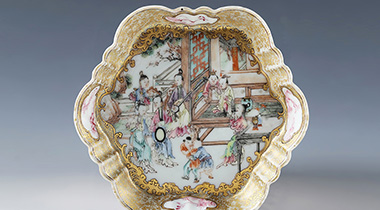
Introduction: Famille-rose porcelain became popular at home and abroad after being developed during the late Kangxi period (1661-1722). In the Yongzheng period, the technique of famille rose reached its peak with the manufacturing of such porcelain in official and private kilns both booming. The famille-rose technique uses glossy white as primer before other color pigments are applied, which can create a gentle transition between colors and create appearance of softness. Therefore it is also called “soft/gentle color decoration”. Small in size, this famille-rose saucer was made during the Yongzheng period. The shape of the rim is derived from the shape of a begonia flower. With pure colors and lustrous body, it has gilt decoration, twining flowers and four panels of landscape patterns in carmine red on the rim. The design in the center is a detailed depiction of children playing in a courtyard with maids standing to the side. The facial expressions of the human figures are vividly depicted, demonstrating the superb painting skills of the craftsmen at that time.
Written by ZHANG Chen
Category: Ornamental Porcelain
Dimensions: 13 cm in diameter, 12 cm in width at foot
Collected by New Youth Hutian Ceramic Community of Jingdezhen
Introduction: Famille-rose porcelain became popular at home and abroad after being developed during the late Kangxi period (1661-1722). In the Yongzheng period, the technique of famille rose reached its peak with the manufacturing of such porcelain in official and private kilns both booming. The famille-rose technique uses glossy white as primer before other color pigments are applied, which can create a gentle transition between colors and create appearance of softness. Therefore it is also called “soft/gentle color decoration”. Small in size, this famille-rose saucer was made during the Yongzheng period. The shape of the rim is derived from the shape of a begonia flower. With pure colors and lustrous body, it has gilt decoration, twining flowers and four panels of landscape patterns in carmine red on the rim. The design in the center is a detailed depiction of children playing in a courtyard with maids standing to the side. The facial expressions of the human figures are vividly depicted, demonstrating the superb painting skills of the craftsmen at that time.
Written by ZHANG Chen
Plate with Design of Maids in Garden in Famille-rose in Yongzheng Reign of Qing Dynasty (1722-1735)
Craftsmanship: Overglaze Decoration (Famille Rose)
Category: Ornamental Porcelain
Dimensions: 23 cm in diameter, 12 cm diameter at foot
Collected by New Youth Hutian Ceramic Community of Jingdezhen
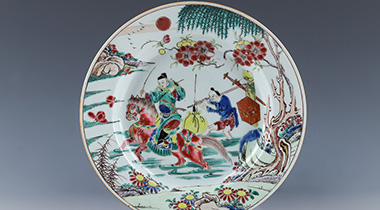
Introduction: Famille-rose porcelain was first produced in the late Kangxi period (1662-1722) and reached its peak in the Yongzheng period, which lasted only 13 years. Due to the high aesthetic tastes of Emperor Yongzheng and the importance he attached to the porcelain produced in the Imperial Kiln Manufactory, the ceramics of this short period saw new development, which was based on the techniques and styles of the Kangxi period. In particular, famille-rose porcelain in the Yongzheng period made progress in craftsmanship and brushwork. This plate has a folded rim with a brown glazed edge, even application of famille rose pigments, pure colors and a delicate clay construction. The folded rim is decorated with three groups of flowers on cut stems. In the central it features the maids playing ancient instruments in a garden. The image of the two maids, elegant and graceful, with vividly depicted facial expressions, transports viewers back to the period of the plate’s production. This plate demonstrates that the charm of porcelain is not only its visual expression of traditional artistic design, but also the expression of emotion and meaning between people. It is exquisitely decorated and in fine condition. This plate is one of the Yongzheng period’s best examples of famille-rose porcelain featuring human figures.
Written by FU Dan
Category: Ornamental Porcelain
Dimensions: 23 cm in diameter, 12 cm diameter at foot
Collected by New Youth Hutian Ceramic Community of Jingdezhen
Introduction: Famille-rose porcelain was first produced in the late Kangxi period (1662-1722) and reached its peak in the Yongzheng period, which lasted only 13 years. Due to the high aesthetic tastes of Emperor Yongzheng and the importance he attached to the porcelain produced in the Imperial Kiln Manufactory, the ceramics of this short period saw new development, which was based on the techniques and styles of the Kangxi period. In particular, famille-rose porcelain in the Yongzheng period made progress in craftsmanship and brushwork. This plate has a folded rim with a brown glazed edge, even application of famille rose pigments, pure colors and a delicate clay construction. The folded rim is decorated with three groups of flowers on cut stems. In the central it features the maids playing ancient instruments in a garden. The image of the two maids, elegant and graceful, with vividly depicted facial expressions, transports viewers back to the period of the plate’s production. This plate demonstrates that the charm of porcelain is not only its visual expression of traditional artistic design, but also the expression of emotion and meaning between people. It is exquisitely decorated and in fine condition. This plate is one of the Yongzheng period’s best examples of famille-rose porcelain featuring human figures.
Written by FU Dan
Containers with Floral and Bird Designs in Ink Enamel Outlined in Gilt in Yongzheng Reign of Qing Dynasty (1722-1735)
Craftsmanship: Overglazed Decoration ( Ink Enamel)
Category: Porcelains for Daily Use
Dimensions: (Cup) 8 cm diameter at mouth with 4 cm height (Plate) 12 cm diameter (Jar) 13.5 cm height
Collected by New Youth Hutian Ceramic Community of Jingdezhen
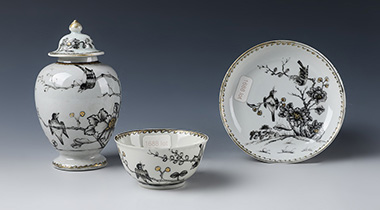
Introduction: Painting designs with ink enamel and outlining them in gilt was a unique technique developed by Jingdezhen potters during the Yongzheng period. It is a particularly precious type of overglaze decoration porcelain. Such porcelain were produced both in imperial and private kilns. This set of exhibits for daily use was ordered by European aristocrats through the East India Company. After three hundred years, parts of this set such as cups and saucers as well as teapots and milk jugs are missing. This set shows adept brushwork skills and tasteful aesthetics. It integrates the Chinese fine brush painting style and western print line style.
Written by ZHANG Chen
Category: Porcelains for Daily Use
Dimensions: (Cup) 8 cm diameter at mouth with 4 cm height (Plate) 12 cm diameter (Jar) 13.5 cm height
Collected by New Youth Hutian Ceramic Community of Jingdezhen
Introduction: Painting designs with ink enamel and outlining them in gilt was a unique technique developed by Jingdezhen potters during the Yongzheng period. It is a particularly precious type of overglaze decoration porcelain. Such porcelain were produced both in imperial and private kilns. This set of exhibits for daily use was ordered by European aristocrats through the East India Company. After three hundred years, parts of this set such as cups and saucers as well as teapots and milk jugs are missing. This set shows adept brushwork skills and tasteful aesthetics. It integrates the Chinese fine brush painting style and western print line style.
Written by ZHANG Chen
A Plate with Floral and Bird Design in Iron Red and Blue and Gilt in Kangxi Reign of Qing Dynasty (1662-1722)
Craftsmanship: Overglaze Decoration
Category: Ornamental Porcelain
Dimensions: 28cm in diameter
Collected by New Youth Hutian Ceramic Community of Jingdezhen
Introduction: The technique of iron-red and blue enamel with gilt decoration was developed in the middle and late Kangxi period. The plate has a refined appearance, with flawless application of glaze and color. Designs of flowers on cut stems on the rim are painted symmetrically, and echo those in the center of the plate, which also includes birds, bamboo and stone. Painted in the style of traditional Chinese ink painting from the period in which the plate was produced, the design has good composition, strong colors and powerful brushwork, and can inspire in viewers a feeling of tranquility. It is an exemplary work of iron-red and blue enamel with gilt decoration from the Kangxi period, and demonstrates the sophisticated overglaze technique and decorative design used in Jingdezhen kilns in the 17th century.
Written by FU Dan
Category: Ornamental Porcelain
Dimensions: 28cm in diameter
Collected by New Youth Hutian Ceramic Community of Jingdezhen
Introduction: The technique of iron-red and blue enamel with gilt decoration was developed in the middle and late Kangxi period. The plate has a refined appearance, with flawless application of glaze and color. Designs of flowers on cut stems on the rim are painted symmetrically, and echo those in the center of the plate, which also includes birds, bamboo and stone. Painted in the style of traditional Chinese ink painting from the period in which the plate was produced, the design has good composition, strong colors and powerful brushwork, and can inspire in viewers a feeling of tranquility. It is an exemplary work of iron-red and blue enamel with gilt decoration from the Kangxi period, and demonstrates the sophisticated overglaze technique and decorative design used in Jingdezhen kilns in the 17th century.
Written by FU Dan
Plate with Floral and Birds Design in Iron Red and Gilding in Kangxi Reign of Qing Dynasty (1662-1722)
Craftsmanship: Overglaze Decoration (Iron Red Painting and Gilding)
Category: Ornamental Porcelain
Dimensions: 23.5 cm in diameter, 12.5cm in diameter at foot
Collected by Jingdezhen Qing Art Museum
Introduction: In the early Qing Dynasty , the iron red painting was a monochrome decoration developed on the basis of the Wucai (five-colored) enamel in the Ming Dynasty. Because of it’s often combination with pure gold, it was called “iron red and gild”. With a strong artistic impact and visual expression, it falls in a famous overglaze porcelain ware in Qing Dynasty. The fine glazed shallow folded rim plate is decorated with paradise flycatchers, peonies, the sun, river landscape in East China and garden vignettes etc. Such combination pattern indicates “longevity and prosperity” and “good fortune”. The composition of the painting is sparse, elegant, delicate and vivid. It not only expresses the traditional Chinese aesthetic of “arranging the void as a real painting”, but also carries out the modern design concept of “replacing the complex with simplicity”. Well-preserved in perfect condition for over three hundred years, it is a valuable classic of iron red and gild ware in Kangxi period.
Written by ZHANG Chen
Category: Ornamental Porcelain
Dimensions: 23.5 cm in diameter, 12.5cm in diameter at foot
Collected by Jingdezhen Qing Art Museum
Introduction: In the early Qing Dynasty , the iron red painting was a monochrome decoration developed on the basis of the Wucai (five-colored) enamel in the Ming Dynasty. Because of it’s often combination with pure gold, it was called “iron red and gild”. With a strong artistic impact and visual expression, it falls in a famous overglaze porcelain ware in Qing Dynasty. The fine glazed shallow folded rim plate is decorated with paradise flycatchers, peonies, the sun, river landscape in East China and garden vignettes etc. Such combination pattern indicates “longevity and prosperity” and “good fortune”. The composition of the painting is sparse, elegant, delicate and vivid. It not only expresses the traditional Chinese aesthetic of “arranging the void as a real painting”, but also carries out the modern design concept of “replacing the complex with simplicity”. Well-preserved in perfect condition for over three hundred years, it is a valuable classic of iron red and gild ware in Kangxi period.
Written by ZHANG Chen
A Cup and a Saucer with Phoenix Design in Blue and White in Kangxi Reign of Qing Dynasty (1662-1722)
Craftsmanship: Underglaze Cobalt Blue Decoration (Blue and White)
Category: Cup and Saucer Set
Dimensions of the Cup: 7.2 cm in diameter at mouth, 4 cm in height with 3.3 cm diameter at foot
Dimensions of Plates: 12cm in diameter with 6.5 cm diameter at foot
Collected by New Youth Hutian Ceramic Community of Jingdezhen
Introduction: The blue and white porcelain of the Kangxi period is the most distinctive in the Qing Dynasty . It features brilliant blue color, exquisite styles, distinct hues and shades, free-style brushwork and diverse themes. Each piece in this set of cups and saucers is embellished with five phoenixes. The phoenix is viewed as the king of birds, and an important and auspicious totem for the Chinese people. The phoenix designs on the cups and saucers echo one another, featuring some birds with raised heads and others in flight. The phoenix design in the center of the saucers is the crucial feature that brings together the overall theme. Without definite name of the painters, the free hand painting provides a beautiful example of the elegant and unrestrained painting style of the craftsmen in Jingdezhen’s Qing Dynasty private kilns.
Written by ZHANG Chen
Category: Cup and Saucer Set
Dimensions of the Cup: 7.2 cm in diameter at mouth, 4 cm in height with 3.3 cm diameter at foot
Dimensions of Plates: 12cm in diameter with 6.5 cm diameter at foot
Collected by New Youth Hutian Ceramic Community of Jingdezhen
Introduction: The blue and white porcelain of the Kangxi period is the most distinctive in the Qing Dynasty . It features brilliant blue color, exquisite styles, distinct hues and shades, free-style brushwork and diverse themes. Each piece in this set of cups and saucers is embellished with five phoenixes. The phoenix is viewed as the king of birds, and an important and auspicious totem for the Chinese people. The phoenix designs on the cups and saucers echo one another, featuring some birds with raised heads and others in flight. The phoenix design in the center of the saucers is the crucial feature that brings together the overall theme. Without definite name of the painters, the free hand painting provides a beautiful example of the elegant and unrestrained painting style of the craftsmen in Jingdezhen’s Qing Dynasty private kilns.
Written by ZHANG Chen
Plate with Panel Flower Patterns in Blue and White in Kangxi Reign of Qing Dynasty (1661-1722)
Craftsmanship: Underglaze Cobalt Blue Decoration (Blue and White)
Category: Ornamental Porcelain
Dimensions: 27cm in diameter, 15cm in foot diameter
Collected by New Youth Hutian Ceramic Community of Jingdezhen
Introduction: This is a classic blue and white plate made in a private kiln during the Kangxi Reign. The shallow plate has a flower-shaped folded rim decorated with twelve season flowers, representing flowers that blossom in each of the 12 months of the year. Flowers are the most common decorative element used on porcelain. They became popular during the Sui and Tang dynasties (581-907) and reached a peak in the Yuan, Ming and Qing dynasties (1271-1911) with the boom of porcelain production in Jingdezhen. The designs generally include winding branches, cut stems, patterns that cover both the interior and exterior of a piece, graphical design and meticulous sketches. The patterns decorating this piece are brilliantly colored with appropriate contrast between light and shade. The patterns on the surface of the plate are divided into seven concentric layers from the edge to the center, which helps to highlight each pattern. The elegant blue and white patterns on the smooth glaze are consistent, fresh and unrestrained, and contain both traditional and contemporary aesthetics. It is a rare and exemplary masterpiece of the Kangxi period.
Written by ZHANG Chen
Category: Ornamental Porcelain
Dimensions: 27cm in diameter, 15cm in foot diameter
Collected by New Youth Hutian Ceramic Community of Jingdezhen
Introduction: This is a classic blue and white plate made in a private kiln during the Kangxi Reign. The shallow plate has a flower-shaped folded rim decorated with twelve season flowers, representing flowers that blossom in each of the 12 months of the year. Flowers are the most common decorative element used on porcelain. They became popular during the Sui and Tang dynasties (581-907) and reached a peak in the Yuan, Ming and Qing dynasties (1271-1911) with the boom of porcelain production in Jingdezhen. The designs generally include winding branches, cut stems, patterns that cover both the interior and exterior of a piece, graphical design and meticulous sketches. The patterns decorating this piece are brilliantly colored with appropriate contrast between light and shade. The patterns on the surface of the plate are divided into seven concentric layers from the edge to the center, which helps to highlight each pattern. The elegant blue and white patterns on the smooth glaze are consistent, fresh and unrestrained, and contain both traditional and contemporary aesthetics. It is a rare and exemplary masterpiece of the Kangxi period.
Written by ZHANG Chen
Plate with Human Figure Design in Blue and White in Kangxi Reign of Qing Dynasty (1662-1722)
Craftsmanship: Underglaze Cobalt Blue Decoration (Blue and White)
Category: Ornamental Porcelain
Dimensions: 24cm in diameter, 13cm diameter at foot
Collected by New Youth Hutian Ceramic Community of Jingdezhen
Introduction: This shallow plate has a wide rim edged in brown glaze and a round foot, with no mark on the blue-and-white-glazed base. The designs in the four highlight panels on the rim depict an absorbed fisher. The pattern in the center is derived from a Chinese mythical story in which two gods playing chess under pine trees attracted a fisher forgetting himself while his hometown took great changes during his stay in the fairy mountain. This plate features vivid depictions of its human characters, lustrous glaze, and thin and light construction, which is typical of blue and white porcelains in the Kangxi period. Chinese historical figures and myths and legends, which are important elements in traditional Chinese culture, became known to people of other countries through porcelain items of this kind.
Written by QIU Xiaoxin
Category: Ornamental Porcelain
Dimensions: 24cm in diameter, 13cm diameter at foot
Collected by New Youth Hutian Ceramic Community of Jingdezhen
Introduction: This shallow plate has a wide rim edged in brown glaze and a round foot, with no mark on the blue-and-white-glazed base. The designs in the four highlight panels on the rim depict an absorbed fisher. The pattern in the center is derived from a Chinese mythical story in which two gods playing chess under pine trees attracted a fisher forgetting himself while his hometown took great changes during his stay in the fairy mountain. This plate features vivid depictions of its human characters, lustrous glaze, and thin and light construction, which is typical of blue and white porcelains in the Kangxi period. Chinese historical figures and myths and legends, which are important elements in traditional Chinese culture, became known to people of other countries through porcelain items of this kind.
Written by QIU Xiaoxin
Set of Cups and Saucers with Human Figure Pattern in Blue and White in Kangxi Reign of Qing Dynasty (1662-1722)
Craftsmanship: Underglaze Cobalt Blue Decoration (Blue and White)
Category: Cups and Saucers for Daily Use
Dimensions of the Cup: 5 cm diameter at mouth, 2.5 cm in height with 2 cm diameter at foot
Dimensions of Saucers: 10 cm in diameter with 5 cm diameter at foot
Collected by New Youth Hutian Ceramic Community of Jingdezhen
Introduction: This set of blue and white cups and saucers with human figure patterns is the typical porcelain produced in Jingdezhen for export to Europe during the Kangxi period. The cups have an out-turned mouth, bulging belly and rounded foot, with white glaze on the base. The shallow saucers have an open mouth and round foot with patterns that echo those on the cups. Each cup and saucer of this series has a different mark on its base, but all are typical of the Kangxi period. They are: “Made in the Chenghua period of the Ming Dynasty ,” “Jade,” “Longevity,” “Made by Fine Jade Shop,” “Precious as Jade” and “Made by Holy Friend Shop.” As exquisite examples of blue and white porcelain in the Kangxi period, this set of cups and saucers features excellent craftsmanship of thin transparent body and lustrous glaze. Its lively blue and white paintings have brilliant color and depict themes that were common among folk artists of the Kangxi period, including A Virtuous Mother Raised Her Young Stepson to be An Official (San Niang Jiao Zi) and Four Famous Beauties in Ancient China and warriors motifs. This kind of small tea set was not widely used in the daily life of the Europeans at that time, as Chinese porcelain was still expensive in Europe. Instead, porcelain of this type was often used to decorate dollhouses, which were popular among women of the aristocracy during this period in Europe. Today, these cups and saucers of the Kangxi period can transport viewers back to the 17th century, when porcelain was as expensive as gold in Europe.
Written by QIU Xiaoxin
Category: Cups and Saucers for Daily Use
Dimensions of the Cup: 5 cm diameter at mouth, 2.5 cm in height with 2 cm diameter at foot
Dimensions of Saucers: 10 cm in diameter with 5 cm diameter at foot
Collected by New Youth Hutian Ceramic Community of Jingdezhen
Introduction: This set of blue and white cups and saucers with human figure patterns is the typical porcelain produced in Jingdezhen for export to Europe during the Kangxi period. The cups have an out-turned mouth, bulging belly and rounded foot, with white glaze on the base. The shallow saucers have an open mouth and round foot with patterns that echo those on the cups. Each cup and saucer of this series has a different mark on its base, but all are typical of the Kangxi period. They are: “Made in the Chenghua period of the Ming Dynasty ,” “Jade,” “Longevity,” “Made by Fine Jade Shop,” “Precious as Jade” and “Made by Holy Friend Shop.” As exquisite examples of blue and white porcelain in the Kangxi period, this set of cups and saucers features excellent craftsmanship of thin transparent body and lustrous glaze. Its lively blue and white paintings have brilliant color and depict themes that were common among folk artists of the Kangxi period, including A Virtuous Mother Raised Her Young Stepson to be An Official (San Niang Jiao Zi) and Four Famous Beauties in Ancient China and warriors motifs. This kind of small tea set was not widely used in the daily life of the Europeans at that time, as Chinese porcelain was still expensive in Europe. Instead, porcelain of this type was often used to decorate dollhouses, which were popular among women of the aristocracy during this period in Europe. Today, these cups and saucers of the Kangxi period can transport viewers back to the 17th century, when porcelain was as expensive as gold in Europe.
Written by QIU Xiaoxin
A Plate with Human Figures in Blue-and-White in Kangxi Reign of Qing Dynasty (1662-1722)
Craftsmanship: Underglaze Cobalt Blue Decoration (Blue and White)
Category: Ornamental Porcelain
Dimensions: 24cm in diameter, 13 cm diameter at foot
Collected by Jingdezhen Qing Art Museum
Introduction: Since its creation at Jingdezhen kiln in the Yuan Dynasty, blue-and-white porcelain has lasted for more than 700 years. It has become a classic of every era due to its unique artistic charm, stable craft form, elegant and pleasing color characteristics, and fruitful motifs. The ancient book A General Introduction of Chinese Ceramic (Tao Ya) of the Qing Dynasty records that “though blue-and-white porcelain collections in Kangxi period are not as lush as those in the Ming Dynasty , they are still uniquely precious in the Qing Dynasty .” Whether from the official or private kilns, blue-and-white porcelain in Kangxi period has always led the development and aesthetic style of this classic porcelain type in the Qing Dynasty for more than three hundred years. Take this plate as an example, the rim of the plate is decorated with geometric patterns and symmetrically laid out two pairs of ruyi-shaped panel decoration. Its interior is painted with a single folding floral decoration. The whole motif is uniform and neat, and extremely rich in the beauty of decorative design. The center of the plate is painted with the scene of two women in a courtyard. The figures are elegant and vivid as if they are authentic, and the glazing color is bright and beautiful. The six-character regular script inscription on the bottom of the plate, “Made in Chenghua Reign of the Ming Dynasty ”, is a common “archaistic inscription” for both official and private kilns in the Kangxi period.
Written by LV Ziqing
Category: Ornamental Porcelain
Dimensions: 24cm in diameter, 13 cm diameter at foot
Collected by Jingdezhen Qing Art Museum
Introduction: Since its creation at Jingdezhen kiln in the Yuan Dynasty, blue-and-white porcelain has lasted for more than 700 years. It has become a classic of every era due to its unique artistic charm, stable craft form, elegant and pleasing color characteristics, and fruitful motifs. The ancient book A General Introduction of Chinese Ceramic (Tao Ya) of the Qing Dynasty records that “though blue-and-white porcelain collections in Kangxi period are not as lush as those in the Ming Dynasty , they are still uniquely precious in the Qing Dynasty .” Whether from the official or private kilns, blue-and-white porcelain in Kangxi period has always led the development and aesthetic style of this classic porcelain type in the Qing Dynasty for more than three hundred years. Take this plate as an example, the rim of the plate is decorated with geometric patterns and symmetrically laid out two pairs of ruyi-shaped panel decoration. Its interior is painted with a single folding floral decoration. The whole motif is uniform and neat, and extremely rich in the beauty of decorative design. The center of the plate is painted with the scene of two women in a courtyard. The figures are elegant and vivid as if they are authentic, and the glazing color is bright and beautiful. The six-character regular script inscription on the bottom of the plate, “Made in Chenghua Reign of the Ming Dynasty ”, is a common “archaistic inscription” for both official and private kilns in the Kangxi period.
Written by LV Ziqing
A Plate with Auspicious Animal Design in Blue and White in Kangxi Reign of Qing Dynasty (1662-1722)
Craftsmanship: Underglaze Cobalt Blue Decoration (Blue and White)
Category: Ornamental Porcelain
Dimensions: 25cm in diameter
Collected by Jingdezhen Qing Art Museum
Introduction: This blue and white porcelain plate with floral rim was produced in a private kiln in Jingdezhen. Such porcelain items used to be exported to Europe during the Kangxi period. The shallow plate has a folded and floral rim that symbolizes auspiciousness. The designs in the panels on the rim match those in the center of the plate, adding to the orderliness of the composition. The paintings are detailed and delicate, especially the patterns on the outermost edge of the rim. The detailed decorative patterns on the rim serve to highlight the kylin and phoenix designs in the center of the plate. In Chinese mythology, the kylin is a gentle animal and the phoenix is the king of birds. Both of these creatures are auspicious in Chinese culture. Such popular themes express people’s expectations for the prosperity of the country. The blue and white porcelain of the Kangxi period is among the best of that made in the Qing Dynasty. Featuring brilliant colors, this plate is an example of the tasteful design of porcelain produced in private kilns during the early Qing Dynasty.
Written by LV Ziqing
Category: Ornamental Porcelain
Dimensions: 25cm in diameter
Collected by Jingdezhen Qing Art Museum
Introduction: This blue and white porcelain plate with floral rim was produced in a private kiln in Jingdezhen. Such porcelain items used to be exported to Europe during the Kangxi period. The shallow plate has a folded and floral rim that symbolizes auspiciousness. The designs in the panels on the rim match those in the center of the plate, adding to the orderliness of the composition. The paintings are detailed and delicate, especially the patterns on the outermost edge of the rim. The detailed decorative patterns on the rim serve to highlight the kylin and phoenix designs in the center of the plate. In Chinese mythology, the kylin is a gentle animal and the phoenix is the king of birds. Both of these creatures are auspicious in Chinese culture. Such popular themes express people’s expectations for the prosperity of the country. The blue and white porcelain of the Kangxi period is among the best of that made in the Qing Dynasty. Featuring brilliant colors, this plate is an example of the tasteful design of porcelain produced in private kilns during the early Qing Dynasty.
Written by LV Ziqing
Set of Cups and Saucers with Landscape Patterns in Blue and White in Kangxi Reign of Qing Dynasty (1662-1722)
5.Craftsmanship: Underglaze Cobalt Blue Decoration (Blue and White)
Category: Cups and Saucers for Daily Use
Dimensions of Cups: 7 cm in diameter at mouth, 3.6 cm in height with 3 cm diameter at foot
Dimensions of Saucers: 12cm in diameter with 6 cm diameter at foot
Collected by New Youth Hutian Ceramic Community of Jingdezhen
Introduction: The blue and white porcelain of the Kangxi period is outstanding among the porcelain produced during the Qing Dynasty . It features brilliant blue color, exquisite style, distinct hues and shades, natural and unrestrained brushwork, and diverse themes. This set of cups and saucers is decorated with scenery pattern of eastern China, painted in the style of traditional Chinese paintings, with the depth of the landscape fully presented within the limited space. The beautiful and tranquil scenery of the mountains and pavilions of eastern China are vividly depicted on the cups and saucers, and are arranged with orderly variation of space. The designs are fine examples of paintings that incorporate both distant and close-up scenery within a small space.
Written by ZHANG Chen
Category: Cups and Saucers for Daily Use
Dimensions of Cups: 7 cm in diameter at mouth, 3.6 cm in height with 3 cm diameter at foot
Dimensions of Saucers: 12cm in diameter with 6 cm diameter at foot
Collected by New Youth Hutian Ceramic Community of Jingdezhen
Introduction: The blue and white porcelain of the Kangxi period is outstanding among the porcelain produced during the Qing Dynasty . It features brilliant blue color, exquisite style, distinct hues and shades, natural and unrestrained brushwork, and diverse themes. This set of cups and saucers is decorated with scenery pattern of eastern China, painted in the style of traditional Chinese paintings, with the depth of the landscape fully presented within the limited space. The beautiful and tranquil scenery of the mountains and pavilions of eastern China are vividly depicted on the cups and saucers, and are arranged with orderly variation of space. The designs are fine examples of paintings that incorporate both distant and close-up scenery within a small space.
Written by ZHANG Chen
Plate with Fish and Aquatic Plant Design in Blue and White and Wucai in Kangxi Reign of Qing Dynasty (1662-1722)
Craftsmanship: (Five-colored) Enamel /Famille verte and Blue and White
Category: Ornamental Porcelain
Dimensions: 23cm in diameter with 12.7 cm diameter at foot
Collected by New Youth Hutian Ceramic Community of Jingdezhen
Introduction: As a popular pattern, this plate features a unique fish design with auspicious connotations of a prosperous life, with four types of freshwater fish on the rim separated by lotus leaves in blue and white, which enrich the decorative designs and make the composition more orderly. The center of the plate features three fish painted in iron red, ingeniously arranged head and tail overlap into a circle. The design on the plate maintains a fashionable aesthetic, despite being produced in Jingdezhen more than three hundred years ago during the Kangxi period. It is an example of a rare variety of porcelain that was sold abroad during the 17th century, which served as a vessel for delivering traditional Chinese culture to the world.
Written by FU Dan
Category: Ornamental Porcelain
Dimensions: 23cm in diameter with 12.7 cm diameter at foot
Collected by New Youth Hutian Ceramic Community of Jingdezhen
Introduction: As a popular pattern, this plate features a unique fish design with auspicious connotations of a prosperous life, with four types of freshwater fish on the rim separated by lotus leaves in blue and white, which enrich the decorative designs and make the composition more orderly. The center of the plate features three fish painted in iron red, ingeniously arranged head and tail overlap into a circle. The design on the plate maintains a fashionable aesthetic, despite being produced in Jingdezhen more than three hundred years ago during the Kangxi period. It is an example of a rare variety of porcelain that was sold abroad during the 17th century, which served as a vessel for delivering traditional Chinese culture to the world.
Written by FU Dan
A Set of Cup and Saucer with Crane Designs in Blue-and-white in Kangxi Reign of Qing Dynasty (1662-1722)
Craftsmanship: Underglaze Cobalt Blue Decoration (Blue and White)
Category: Porcelain for Daily Use
Dimensions: 6cm in diameter at mouth, 7cm in height
Collection Category: Ceramic for Daily-use
Dimension of cup: 7.2cm diameter at mouth, 3.3cm diameter at foot, 4cm in height
Dimension of saucer: 12cm diameter, 6.5cm basal diameter
Collected by New Youth Hutian Ceramic Community of Jingdezhen
Introduction: Blue and white porcelain in Kangxi period is the most distinctive variety in Qing Dynasty . For the color is elegant and rich, the layers are well defined, the brushwork strong and suave, and the subject matter rich. This set is typical of Jingdezhen private kilns in Kangxi period and is designed with the “five cranes”, also known as the “the first rank of the dynasty”. The crane designs on the set are symmetrical and orderly, with some flying and others looking on, and the central reserved panel is decorated with the motif “ the first rank of the dynasty”. The cranes are standing on rocks with the red sun in the sky and the waves rolling in, signifying the first rank of the dynasty, good fortune and longevity. The crane is the head of the feathered family and is known as the “bird of the first class”. In our traditional bird culture, the crane is a bird of good fortune, second only to the phoenix. And it is a metaphor for the supremacy of human servants. Tide and dynasty are pronounced the same way in Chinese. And the cranes are standing on the rocks when the tide is in, signifying "the first rank of the dynasty", indicating a high official position and a long and prosperous life. The crane design has accompanied the growth of traditional culture and is an important totem for the Chinese people. Those unnamed Jingdezhen painters, with their skillful and dashing brushwork, perfectly interpret the ancient people's expectations and pursuit of good fortune.
Written by ZHANG Chen
Category: Porcelain for Daily Use
Dimensions: 6cm in diameter at mouth, 7cm in height
Collection Category: Ceramic for Daily-use
Dimension of cup: 7.2cm diameter at mouth, 3.3cm diameter at foot, 4cm in height
Dimension of saucer: 12cm diameter, 6.5cm basal diameter
Collected by New Youth Hutian Ceramic Community of Jingdezhen
Introduction: Blue and white porcelain in Kangxi period is the most distinctive variety in Qing Dynasty . For the color is elegant and rich, the layers are well defined, the brushwork strong and suave, and the subject matter rich. This set is typical of Jingdezhen private kilns in Kangxi period and is designed with the “five cranes”, also known as the “the first rank of the dynasty”. The crane designs on the set are symmetrical and orderly, with some flying and others looking on, and the central reserved panel is decorated with the motif “ the first rank of the dynasty”. The cranes are standing on rocks with the red sun in the sky and the waves rolling in, signifying the first rank of the dynasty, good fortune and longevity. The crane is the head of the feathered family and is known as the “bird of the first class”. In our traditional bird culture, the crane is a bird of good fortune, second only to the phoenix. And it is a metaphor for the supremacy of human servants. Tide and dynasty are pronounced the same way in Chinese. And the cranes are standing on the rocks when the tide is in, signifying "the first rank of the dynasty", indicating a high official position and a long and prosperous life. The crane design has accompanied the growth of traditional culture and is an important totem for the Chinese people. Those unnamed Jingdezhen painters, with their skillful and dashing brushwork, perfectly interpret the ancient people's expectations and pursuit of good fortune.
Written by ZHANG Chen
Plate with Floral Designs of Treasure & Fairy Flower Pattern in Wucai in Kangxi Reign of Qing Dynasty (1662-1722)
Technique: Overglazed decoration(Wucai (five-colored) Enamel /Famille verte)
Category: Ornamental Porcelain
Dimension: 23cm diameter, 11.5cm diameter at foot
Collected by New Youth Hutian Ceramic Community of Jingdezhen
Introduction: This plate has a wide rim, curved belly and ring foot, with a blue and white double-ringed floral decoration mark on the bottom. The rim of the plate is decorated with four groups of Bogu (a quaint pattern of Chinese traditional decoration) and begonia floral motifs decorated in reserved panels. The main motif in the center is painted with treasure and fairy flower pattern, and the back with three groups of floral sprays. Its design is bright and bold in color with novel paintings and vigorous brushwork. Wucai Enamel in Kangxi is a quaint wonder in the history of ceramics. Except the iron red, the colors on this plate, green, yellow, purple, and blue, are in bright and translucent tone with the emphasis of bold colors and bright jewel-like texture, so it is also known as “Yingcai” (hard color). This plate is well inherited and once was housed in the collection of Bernheimer, a well-renown German collector of Kangxi Wucai porcelain, with a collection label on the bottom, and has survived more than three hundred years, undergone great changes, and travelled overseas for several times. Still, it remains in good condition and is reputed as one of the exceptional works of Kangxi Wucai porcelain.
Written by QIU Xiaoxin
Category: Ornamental Porcelain
Dimension: 23cm diameter, 11.5cm diameter at foot
Collected by New Youth Hutian Ceramic Community of Jingdezhen
Introduction: This plate has a wide rim, curved belly and ring foot, with a blue and white double-ringed floral decoration mark on the bottom. The rim of the plate is decorated with four groups of Bogu (a quaint pattern of Chinese traditional decoration) and begonia floral motifs decorated in reserved panels. The main motif in the center is painted with treasure and fairy flower pattern, and the back with three groups of floral sprays. Its design is bright and bold in color with novel paintings and vigorous brushwork. Wucai Enamel in Kangxi is a quaint wonder in the history of ceramics. Except the iron red, the colors on this plate, green, yellow, purple, and blue, are in bright and translucent tone with the emphasis of bold colors and bright jewel-like texture, so it is also known as “Yingcai” (hard color). This plate is well inherited and once was housed in the collection of Bernheimer, a well-renown German collector of Kangxi Wucai porcelain, with a collection label on the bottom, and has survived more than three hundred years, undergone great changes, and travelled overseas for several times. Still, it remains in good condition and is reputed as one of the exceptional works of Kangxi Wucai porcelain.
Written by QIU Xiaoxin
A Plate with Floral Designs in Wucai in Kangxi Reign of Qing Dynasty (1662-1722)
Craftsmanship: Overglazed Decoration(Polychrome/Wucai Enamel/Famille Verte)
Category: Ornamental Porcelain
Dimension: 30cm diameter, 15cm diameter at foot
Collected by Jingdezhen Qing Art Museum
Introduction: The Wucai Enamel porcelain in Kangxi Reign featured with bold brilliant colors, gradually developed and advanced from the achievements of Wucai in Ming Dynasty, reputed as a masterpiece of Qing Dynasty porcelain. It exceled in a style of strong aesthetic perception and visual expression, and immediately became a hit after entering the European market in the 17th and 18th centuries. Meanwhile, it also laid the groundwork for enamel and famille rose porcelain. This plate is mainly decorated with floral motifs, and the rim. Its center was separately encircled by a ring of copper cash decoration, four groups of floral sprays, four groups of floral sprays in reserved panels on brocade ground as well as a central floral motif painting. The overall color design is rich, bright and crisp with elegant painting style and fine calligraphy. From the perspective of modern design, the layout of the picture is in full accordance with decorative beauty of form, emphasizing symmetry and contrast and the main and side decorations mutually complementing, reflecting the strong aesthetic ability and time-honored artistic expression of traditional ceramic design. Withstand the test of time, this plate still remains wonderful and stylish in contemporary aesthetics through the transitions within more than three hundred years.
Written by LV Ziqing
Category: Ornamental Porcelain
Dimension: 30cm diameter, 15cm diameter at foot
Collected by Jingdezhen Qing Art Museum
Introduction: The Wucai Enamel porcelain in Kangxi Reign featured with bold brilliant colors, gradually developed and advanced from the achievements of Wucai in Ming Dynasty, reputed as a masterpiece of Qing Dynasty porcelain. It exceled in a style of strong aesthetic perception and visual expression, and immediately became a hit after entering the European market in the 17th and 18th centuries. Meanwhile, it also laid the groundwork for enamel and famille rose porcelain. This plate is mainly decorated with floral motifs, and the rim. Its center was separately encircled by a ring of copper cash decoration, four groups of floral sprays, four groups of floral sprays in reserved panels on brocade ground as well as a central floral motif painting. The overall color design is rich, bright and crisp with elegant painting style and fine calligraphy. From the perspective of modern design, the layout of the picture is in full accordance with decorative beauty of form, emphasizing symmetry and contrast and the main and side decorations mutually complementing, reflecting the strong aesthetic ability and time-honored artistic expression of traditional ceramic design. Withstand the test of time, this plate still remains wonderful and stylish in contemporary aesthetics through the transitions within more than three hundred years.
Written by LV Ziqing
A Plate with Flowers and Birds Design in Wucai in Kangxi Reign of Qing Dynasty (1662-1722)
Craftsmanship: Overglaze Decoration (Five-colored) Enamel /Famille verte
Category: Ornamental Porcelain
Dimensions: 23cm in diameter, 12 cm diameter at foot
Collected by New Youth Hutian Ceramic Community of Jingdezhen
Introduction: The Wucai (five-colored) enamel porcelain of the Kangxi period developed from that produced during the Ming Dynasty (1368-1644), but far exceeded it in craftsmanship, coloring, brushwork and artistic merit. This shallow plate has a wide and brown-glazed rim, and round foot, with blue and white double circles on its white-glazed base. With dots and flowers as the background, the rim of the plate is embellished with grass and insect designs in four highlight panels. In the center of the plate there are colorful flowers, insects and a pair of reluctantly parting kingfishers, with one turning back to regard the other as it departs. The scene depicted on the plate, using Chinese brushwork to create this natural scene, is full of vitality and harmony. With brilliant and sumptuous colors, appropriate use of space, fine clay construction, lustrous enamel, and well-preserved colors, the plate shows the exquisite craftsmanship of Wucai porcelain in the Kangxi period.
Written by QIU Xiaoxin
Category: Ornamental Porcelain
Dimensions: 23cm in diameter, 12 cm diameter at foot
Collected by New Youth Hutian Ceramic Community of Jingdezhen
Introduction: The Wucai (five-colored) enamel porcelain of the Kangxi period developed from that produced during the Ming Dynasty (1368-1644), but far exceeded it in craftsmanship, coloring, brushwork and artistic merit. This shallow plate has a wide and brown-glazed rim, and round foot, with blue and white double circles on its white-glazed base. With dots and flowers as the background, the rim of the plate is embellished with grass and insect designs in four highlight panels. In the center of the plate there are colorful flowers, insects and a pair of reluctantly parting kingfishers, with one turning back to regard the other as it departs. The scene depicted on the plate, using Chinese brushwork to create this natural scene, is full of vitality and harmony. With brilliant and sumptuous colors, appropriate use of space, fine clay construction, lustrous enamel, and well-preserved colors, the plate shows the exquisite craftsmanship of Wucai porcelain in the Kangxi period.
Written by QIU Xiaoxin
An Imari-style plate with Floral and Bird Designs in Kangxi Period of Qing Dynasty (1662-1722)
Process Category: Comprehensive Decoration (Carving, Blue and White, Iron Red, Gilding)
Collection Category: Ornamental Porcelain
Dimension: 24cm diameter, 12cm basal diameter
Collected by Jingdezhen Art Museum
Introduction: This is an “Imari-style” plate in Kangxi period in Qing Dynasty. Such a traditional ornamental porcelain ware integrates underglaze cobalt blue decoration with overglaze iron red and gild, and a rare combination of ceramic carving. The shallow folded rim plate is decorated with iron red and gild geometric patterns on the edging from outside to inside. The decoration of carving, blue and white, iron red and gild together with four reserved panels make the birds dynamic and interesting and the flowers numerous and full. The work as a whole is skillfully painted and finished in a single stroke with sharp knife-work. Both the painting and the carving appear to be well-handled and well-conceived. It reflects the superb porcelain-making techniques and plain craftsmanship of Jingdezhen private kilns in the late Kangxi period of the Qing Dynasty.
Written by LV Ziqing
Collection Category: Ornamental Porcelain
Dimension: 24cm diameter, 12cm basal diameter
Collected by Jingdezhen Art Museum
Introduction: This is an “Imari-style” plate in Kangxi period in Qing Dynasty. Such a traditional ornamental porcelain ware integrates underglaze cobalt blue decoration with overglaze iron red and gild, and a rare combination of ceramic carving. The shallow folded rim plate is decorated with iron red and gild geometric patterns on the edging from outside to inside. The decoration of carving, blue and white, iron red and gild together with four reserved panels make the birds dynamic and interesting and the flowers numerous and full. The work as a whole is skillfully painted and finished in a single stroke with sharp knife-work. Both the painting and the carving appear to be well-handled and well-conceived. It reflects the superb porcelain-making techniques and plain craftsmanship of Jingdezhen private kilns in the late Kangxi period of the Qing Dynasty.
Written by LV Ziqing
An Imari-style Plate with Human Figure Design in Kangxi Reign of Qing Dynasty (1662-1722)
Craftsmanship: Overglaze and Underglaze Decoration
Category: Ornamental Porcelain
Dimensions: 25cm in diameter
Collected by Jingdezhen Qing Art Museum
Introduction: The 17th and 18th centuries was a boom time in porcelain trade between Eastern and Western countries. As the most important porcelain maker, China played a leading role in the trade. Due to a ban on marine trade in the early Qing Dynasty, China’s export almost came to a standstill. During this period, the high-quality Imari style ceramics produced in the Arita region of Japan replaced Chinese ceramics and became popular in the West.
After the ban on ocean trade was lifted in the 22nd year of the Kangxi Reign (1683), the trade on the Maritime Silk Route between China and the West resumed and developed rapidly. Many European countries began sending orders for Imari wares to Jingdezhen. Owing to Jingdezhen’s advanced methods of porcelain production, the quality of manufacturing techniques and the design of Imari-style products produced there exceeded what was made in Japan. After that, the Imari-style became localized and developed in China. The plate is such one produced in the Kangxi period and features underglaze blue and white patterns and overglaze iron red and gilt decoration. The figures are vividly depicted. Surrounded by designs of children playing games on the rim, the central picture is derived from The Story of the Western Wing, a romance written in the 13th century. The scene of the two protagonists meeting with each other conveys the wishes of lovers to be together during a period in which free courtship was not allowed.
Written by LV Ziqing
Category: Ornamental Porcelain
Dimensions: 25cm in diameter
Collected by Jingdezhen Qing Art Museum
Introduction: The 17th and 18th centuries was a boom time in porcelain trade between Eastern and Western countries. As the most important porcelain maker, China played a leading role in the trade. Due to a ban on marine trade in the early Qing Dynasty, China’s export almost came to a standstill. During this period, the high-quality Imari style ceramics produced in the Arita region of Japan replaced Chinese ceramics and became popular in the West.
After the ban on ocean trade was lifted in the 22nd year of the Kangxi Reign (1683), the trade on the Maritime Silk Route between China and the West resumed and developed rapidly. Many European countries began sending orders for Imari wares to Jingdezhen. Owing to Jingdezhen’s advanced methods of porcelain production, the quality of manufacturing techniques and the design of Imari-style products produced there exceeded what was made in Japan. After that, the Imari-style became localized and developed in China. The plate is such one produced in the Kangxi period and features underglaze blue and white patterns and overglaze iron red and gilt decoration. The figures are vividly depicted. Surrounded by designs of children playing games on the rim, the central picture is derived from The Story of the Western Wing, a romance written in the 13th century. The scene of the two protagonists meeting with each other conveys the wishes of lovers to be together during a period in which free courtship was not allowed.
Written by LV Ziqing
A Set of Cup and Saucer with Landscape Design in Blue and White in Qianlong Reign of Qing Dynasty (1736-1795)
Craftsmanship: Underglaze Cobalt Blue Decoration (Blue and White)
Category: Porcelain for Daily Use
Dimensions of Cup: 6cm in diameter at mouth, 5 cm in height
Dimensions of Saucer: 12 cm in diameter, 8.2 cm in diameter at foot
Collected by New Youth Hutian Ceramic Community of Jingdezhen
Introduction: This cup has a slightly flared rim, bulging belly and round foot. The bottom is glazed in white without a mark and the edge of the rim is colored with brown glaze. The shallow saucer has an open mouth and round foot, with white glaze on the base carrying no marks. The rim of the saucer is edged in brown glaze. The cup and saucer are decorated with blue and white landscape designs. The rims of the interior walls of both the cup and saucer are also decorated with blue and white flower patterns, while the exteriors are embellished with landscape patterns. This cup and saucer set features exquisite paintings with distinct light and shade. The design depicts friends meeting to play musical instruments, with mountains, pavilions, fishing boats and egrets in the blue sky in the distance. It offers a vivid depiction of the landscape of eastern China with a broad horizon and profound connotations. Landscape painting is the quintessence of the Chinese culture and philosophy, which delivers the Confucianism and Taoism traditions. Although the designs are small in size, they express a mindset of detachment and a preference for natural scenery, which reflects the eternal harmonious relationship between humans, nature and the universe.
Written by QIU Xiaoxin
Category: Porcelain for Daily Use
Dimensions of Cup: 6cm in diameter at mouth, 5 cm in height
Dimensions of Saucer: 12 cm in diameter, 8.2 cm in diameter at foot
Collected by New Youth Hutian Ceramic Community of Jingdezhen
Introduction: This cup has a slightly flared rim, bulging belly and round foot. The bottom is glazed in white without a mark and the edge of the rim is colored with brown glaze. The shallow saucer has an open mouth and round foot, with white glaze on the base carrying no marks. The rim of the saucer is edged in brown glaze. The cup and saucer are decorated with blue and white landscape designs. The rims of the interior walls of both the cup and saucer are also decorated with blue and white flower patterns, while the exteriors are embellished with landscape patterns. This cup and saucer set features exquisite paintings with distinct light and shade. The design depicts friends meeting to play musical instruments, with mountains, pavilions, fishing boats and egrets in the blue sky in the distance. It offers a vivid depiction of the landscape of eastern China with a broad horizon and profound connotations. Landscape painting is the quintessence of the Chinese culture and philosophy, which delivers the Confucianism and Taoism traditions. Although the designs are small in size, they express a mindset of detachment and a preference for natural scenery, which reflects the eternal harmonious relationship between humans, nature and the universe.
Written by QIU Xiaoxin